

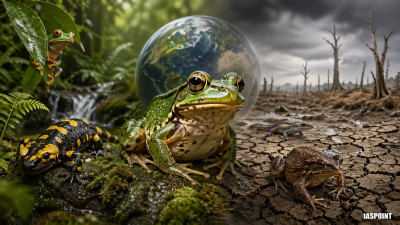
Amphibians are currently the most threatened group of vertebrates globally. According to the IUCN, approximately 41% of all amphibian species are threatened with extinction. Their conservation is vital not only for biodiversity but also for the ecological services they provide, such as pest control and acting as bio-indicators.
1. Primary Threats to Amphibians
Understanding the drivers of decline is essential for formulating conservation strategies.
- Habitat Loss and Fragmentation: The drainage of wetlands, deforestation, and conversion of land for agriculture are the leading causes of population decline.
- Chytridiomycosis: A lethal skin disease caused by the Chytrid fungus (Batrachochytrium dendrobatidis). It interferes with the amphibian’s ability to breathe and regulate electrolytes through its skin.
- Climate Change: Rising global temperatures lead to the drying of breeding pools and alter the humidity levels required for cutaneous respiration.
- Environmental Pollution: Pesticides, herbicides (like Atrazine), and heavy metals are easily absorbed through amphibian skin, leading to reproductive failure and developmental deformities.
- Over-exploitation: Illegal trade for the pet market and the harvesting of frogs for “frog legs” in the food industry.
2. Legal Framework in India
India is home to a high diversity of amphibians, particularly in the Western Ghats and North-East India.
- Wildlife (Protection) Act, 1972: Several species are protected under various schedules. For example, the Indian Bullfrog (Hoplobatrachus tigerinus) is protected under Schedule II, making its killing or trade a punishable offense.
- CITES (Convention on International Trade in Endangered Species): Regulates the international trade of threatened amphibians to ensure it does not threaten their survival.
- Biodiversity Act, 2002: Focuses on the conservation of biological diversity and sustainable use of its components, which includes protecting endemic amphibian habitats.
3. Conservation Strategies: In-situ and Ex-situ
| Strategy Type | Method | Description |
| In-situ | Protected Areas | Creating National Parks and Wildlife Sanctuaries in biodiversity hotspots like the Western Ghats. |
| In-situ | Ecological Corridors | Connecting fragmented habitats to allow for genetic exchange between isolated populations. |
| Ex-situ | Captive Breeding | Breeding endangered species in controlled environments (zoos/labs) to release them back into the wild (e.g., the “Amphibian Ark” project). |
| Ex-situ | Cryopreservation | Storing amphibian sperm and embryos at very low temperatures to preserve genetic diversity. |
4. International Initiatives
- Amphibian Specialist Group (ASG): A global network of experts under the IUCN Species Survival Commission that provides scientific data for conservation.
- Global Amphibian Assessment (GAA): A comprehensive analysis of the conservation status of all known amphibian species.
- Save The Frogs! Day: An international day of political action and public education regarding the amphibian extinction crisis.
5. Notable Conservation Successes and Facts
- Purple Frog (Nasikabatrachus sahyadrensis): Intense community-led conservation in Kerala has focused on preserving the specific underground burrows and breeding streams of this “living fossil.”
- The Lost Frogs Project: A global search launched to rediscover species that haven’t been seen in decades; it has successfully located several “extinct” species in various parts of the world.
- Citizen Science: Mobile applications like “India Biodiversity Portal” allow citizens to record sightings, helping scientists map amphibian distribution and identify new threats.
6. Management Challenges for UPSC Prelims
- Data Deficiency: Many amphibian species are “Data Deficient” (DD) under IUCN, making it difficult to implement targeted conservation.
- Sensitivity to pH: Management of water bodies must ensure that pH levels remain stable, as acidic water (from acid rain) can cause 100% mortality in amphibian eggs.
- Transboundary Conservation: Since amphibians do not recognize political borders, conservation requires cooperation between neighboring countries (e.g., India-Nepal, India-Bhutan).
Summary for Quick Revision
| Keyword | Significance |
| Chytrid Fungus | Major pathogen causing global declines. |
| Bio-indicator | Species reflecting health of the environment. |
| Endemic | Species restricted to a specific region (e.g., Western Ghats). |
| Anamniotic | Eggs without shells, highly sensitive to pollutants. |