

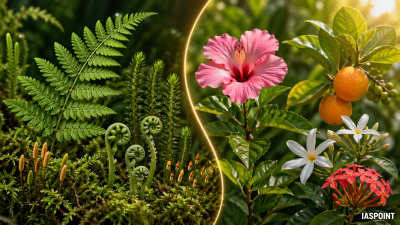
The Plant Kingdom (Plantae) is broadly classified into two major groups based on their reproductive structures: Cryptogams (seedless/flowerless) and Phanerogams (seed-bearing).
Cryptogams: The Lower Plants
The term Cryptogamae (Greek kryptos = hidden, gamos = marriage) refers to plants that reproduce through spores and do not produce seeds or flowers.
Bryophytes: The Amphibians of the Plant Kingdom
Bryophytes represent the first transition from aquatic to terrestrial life.
- Habitat: Require water for sexual reproduction (sperm swim to the egg). Found in moist, shaded areas.
- Body Structure: Lack true roots, stems, or leaves; possess root-like rhizoids.
- Vascular System: Non-vascular (lack Xylem and Phloem).
- Examples: Riccia, Marchantia (Liverworts), and Sphagnum (Peat Moss).
- UPSC Fact: Sphagnum is used as fuel (peat) and as packing material for trans-shipment of living material due to its high water-holding capacity.
Pteridophytes: The First Terrestrial Vascular Plants
Pteridophytes are evolutionary pioneers as they were the first plants to develop specialized tissues for conduction.
- Vascular System: Possess true Xylem and Phloem (but lack vessels in xylem and companion cells in phloem in most species).
- Body Structure: Differentiated into true roots, stems, and leaves.
- Reproduction: Produce spores; the dominant phase is the Sporophyte.
- Examples: Selaginella, Equisetum (Horsetail), Adiantum (Walking fern), and Azolla.
- UPSC Fact: Azolla is a water fern used extensively as a bio-fertilizer in paddy fields due to its symbiotic association with nitrogen-fixing Cyanobacteria (Anabaena).
Phanerogams: The Higher Plants (Spermatophytes)
Phanerogams (Greek phaneros = visible) are characterized by well-differentiated reproductive tissues that produce seeds.
Gymnosperms: The Naked Seed Plants
Gymnosperms (Greek gymnos = naked, sperma = seed) are plants where the ovules are not enclosed by an ovary wall and remain exposed both before and after fertilization.
- Morphology: Generally perennial, woody, and evergreen. They often have needle-like leaves to reduce surface area (adaptation to extreme temperatures/humidity).
- Roots: Often have fungal associations (Mycorrhiza in Pinus) or specialized roots (Coralloid roots in Cycas associated with N2-fixing microbes).
- Vascular System: Well-developed; however, Xylem lacks vessels and Phloem lacks companion cells.
- Examples: Pinus, Cycas, Cedrus (Deodar), and Sequoia (Giant Redwood—one of the tallest tree species).
Comparative Analysis: Bryophytes, Pteridophytes, and Gymnosperms
| Feature | Bryophytes | Pteridophytes | Gymnosperms |
| Common Name | Amphibians of Plant Kingdom | Botanical Snakes | Naked-seeded plants |
| Vascular Tissue | Absent | Present (First to evolve) | Present (Advanced) |
| Plant Body | Thallus-like (No true roots/stems) | Differentiated (Root, stem, leaves) | Differentiated (Advanced) |
| Dominant Phase | Gametophyte (Haploid) | Sporophyte (Diploid) | Sporophyte (Diploid) |
| Seeds | Absent (Spores) | Absent (Spores) | Present (Naked) |
| Water for Fertilization | Essential | Essential | Not required (Pollen tubes) |
Evolution of Reproductive Structures
Heterospory and Seed Habit
- Pteridophyte Origin: Certain Pteridophytes like Selaginella and Salvinia produce two kinds of spores: Macro (large) and Micro (small). This condition is known as Heterospory.
- Significance: The development of the zygote into young embryos takes place within the female gametophyte. This event is considered a precursor to the Seed Habit, a crucial step in plant evolution.
Pollination Mechanism in Gymnosperms
- Unlike Bryophytes and Pteridophytes which rely on water, Gymnosperms primarily use Anemophily (wind pollination).
- The pollen grains are released from the microsporangium and carried by air currents to reach the opening of the ovules.
Key Trivia for UPSC Prelims
- Living Fossils: Ginkgo biloba and Cycas are often referred to as living fossils because they have remained unchanged for millions of years.
- Economic Botany: Taxus (a gymnosperm) yields ‘Taxol’, a drug used in cancer treatment.
- Tallest Plant: Sequoia sempervirens (Gymnosperm) is the tallest known tree species globally.
- Smallest Pteridophyte: Azolla is the smallest known fern, critical for organic farming.
- Resin and Turpentine: Obtained from Pinus species (Gymnosperms), used in the paint and varnish industry.