

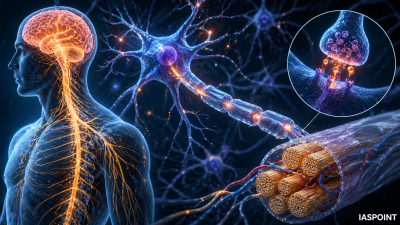
Nervous tissue is the primary component of the central nervous system (brain and spinal cord) and the peripheral nervous system (nerves). It is specialized for the rapid conduction of electrical impulses, allowing the body to sense stimuli, process information, and initiate responses. Derived from the ectoderm, it is the most complex tissue in the human body.
Composition of Nervous Tissue
Nervous tissue is composed of two main types of cells: Neurons and Neuroglia.
1. Neurons (Nerve Cells)
Neurons are the structural and functional units of the nervous system. Unlike most other cells, mature neurons do not undergo cell division (mitosis).
- Cyton (Cell Body): Contains the nucleus and cytoplasm (neuroplasm). It features Nissl’s granules, which are rich in RNA and involved in protein synthesis.
- Dendrites: Short, branched projections that receive incoming impulses from other neurons or sensory receptors and carry them toward the cyton.
- Axon: A single, long fiber that carries impulses away from the cyton to another neuron or an effector organ (muscle/mask).
- Myelin Sheath: A fatty insulating layer found on some axons, produced by Schwann cells in the peripheral nervous system. It increases the speed of impulse conduction.
- Nodes of Ranvier: Microscopic gaps in the myelin sheath that facilitate saltatory conduction (jumping of impulses).
2. Neuroglia (Glial Cells)
Neuroglia are non-conducting cells that provide support, nourishment, and protection to neurons. They make up more than half the volume of neural tissue in the human body.
- Astrocytes: Star-shaped cells that maintain the blood-brain barrier and regulate the chemical environment.
- Oligodendrocytes: Responsible for forming the myelin sheath in the Central Nervous System (CNS).
- Microglia: Act as specialized macrophages (immune cells) to clear debris and pathogens.
- Ependymal Cells: Line the ventricles of the brain and help in the production of Cerebrospinal Fluid (CSF).
Classification of Neurons
Neurons are classified based on the number of processes (axon and dendrites) extending from the cell body:
| Type | Structure | Common Location |
| Unipolar | Cell body with one axon only | Found usually in the embryonic stage |
| Bipolar | One axon and one dendrite | Retina of the eye, olfactory epithelium |
| Multipolar | One axon and two or more dendrites | Cerebral cortex (most common type) |
| Pseudounipolar | Single process that branches into two | Dorsal root ganglia of spinal nerves |
Mechanism of Nerve Impulse Transmission
Nervous tissue functions through electrochemical signals.
- Synapse: The functional junction between two neurons.
- Neurotransmitters: Chemical messengers like Acetylcholine or Dopamine that cross the synaptic cleft to transmit the signal to the next neuron.
- Direction of Flow: Dendrite → Cyton → Axon → Axon Terminal → Synapse → Next Neuron.
Functional Classification of Nervous Tissue
- Sensory (Afferent) Neurons: Conduct impulses from sensory receptors (skin, eyes, ears) toward the Central Nervous System.
- Motor (Efferent) Neurons: Conduct impulses away from the CNS to effectors like muscles and glands.
- Interneurons (Association Neurons): Located entirely within the CNS; they integrate data and relay signals between sensory and motor neurons.
Key Facts and Trivia for UPSC
- Largest Cell: The neuron is the longest cell in the human body, with some axons reaching up to a meter in length.
- Refractory Period: The brief interval after a nerve impulse during which a neuron cannot fire another impulse.
- All-or-None Law: A nerve fiber responds maximally or not at all to a stimulus; increasing the strength of the stimulus beyond the threshold does not increase the strength of the impulse.
- Blood-Brain Barrier (BBB): A highly selective semipermeable border formed by endothelial cells and astrocytes that prevents harmful solutes in the blood from entering the central nervous system.
- Grey Matter vs. White Matter: Grey matter consists mainly of neuron cell bodies and unmyelinated fibers, while white matter consists of myelinated axons.
Functions of Nervous Tissue
- Sensation: Detecting internal and external environmental changes.
- Integration: Processing sensory input and making decisions (memory, thought, and emotion).
- Homeostasis: Regulating body temperature, blood pressure, and sleep-wake cycles through the autonomic nervous system.
- Motor Output: Stimulating muscle contraction or glandular secretion in response to processed information.