

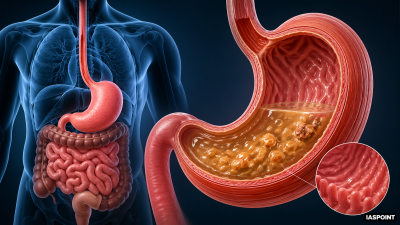
The stomach is a thick-walled, J-shaped muscular bag-like organ located in the upper left portion of the abdominal cavity. It serves as a vital link between the oesophagus and the small intestine. In the stomach, food is stored for 4–5 hours and undergoes both mechanical churning and chemical digestion.
Anatomical Divisions
The stomach is structurally divided into four major regions:
- Cardiac Region: The upper portion located near the heart, where the oesophagus opens.
- Fundus: The dome-shaped superior region, usually filled with air or gas.
- Body: The main central region where the bulk of digestion occurs.
- Pyloric Region: The lower portion that opens into the first part of the small intestine (duodenum).
Gastric Histology and Secretions
The mucosa of the stomach contains gastric glands, which possess three main types of cells essential for digestion:
- Mucous Neck Cells: Secrete mucus to protect the stomach lining from the highly acidic environment.
- Peptic or Chief Cells: Secrete the proenzyme pepsinogen.
- Parietal or Oxyntic Cells: Secrete Hydrochloric Acid (HCl) and Intrinsic Factor (essential for the absorption of Vitamin B12).
Physiology of Digestion in the Stomach
The stomach performs mechanical digestion through muscular contractions (churning) and chemical digestion via gastric juice.
- Chyme: The food is thoroughly mixed with acidic gastric juice by the churning movements of its muscular wall, forming a semi-fluid mass called chyme.
- Protein Digestion: Pepsinogen, on exposure to HCl, gets converted into the active enzyme pepsin. Pepsin converts proteins into proteoses and peptones (peptides).Pepsinogen HCl→ PepsinProteins Pepsin→ Proteoses + Peptones
- Digestion in Infants: Rennin (not to be confused with the hormone renin) is a proteolytic enzyme found in the gastric juice of infants which helps in the digestion of milk proteins (casein).
Key Functions of Gastric HCl
HCl maintains a highly acidic pH (approximately 1.8), which is optimal for pepsin. Its primary roles include:
- Activating inactive pepsinogen into active pepsin.
- Killing bacteria and other harmful microorganisms ingested with food.
- Softening hard food particles.
- Stopping the action of salivary amylase (which requires a near-neutral pH).
Comparison of Stomach Features
| Feature | Description/Function |
| Rugae | Irregular folds in the inner lining that allow the stomach to expand. |
| Cardiac Sphincter | Prevents backflow of acid into the oesophagus. |
| Pyloric Sphincter | Regulates the release of chyme into the duodenum. |
| Castle’s Intrinsic Factor | Secreted by parietal cells; critical for Vitamin B12 absorption in the ileum. |
UPSC Prelims Fact File
- Absorption: While the stomach is primarily for digestion, limited absorption of water, simple sugars, and alcohol takes place here.
- Protection: The mucus and bicarbonates present in the gastric juice play a crucial role in lubrication and protection of the mucosal epithelium from excoriation by the highly concentrated HCl.
- Gastrin: A hormone secreted by “G cells” in the pyloric antrum that stimulates the release of gastric acid.
- Gastric Lipase: The stomach secretes a very small amount of lipases, though the majority of fat digestion occurs in the small intestine.
- Peptic Ulcers: Often caused by the bacterium Helicobacter pylori or excessive use of NSAIDs (painkillers), which erode the protective mucus lining.