

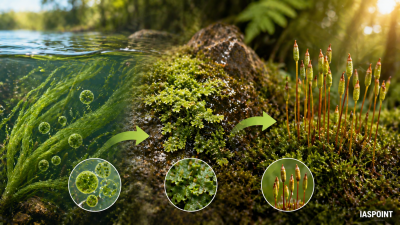
Bryophytes occupy a unique evolutionary position as the “Amphibians of the Plant Kingdom.” They are the simplest and most primitive land plants, representing the bridge between aquatic algae and vascular terrestrial plants.
Salient Features of Bryophytes
Bryophytes are non-vascular plants, meaning they lack specialized tissues (Xylem and Phloem) for the conduction of water and nutrients.
- Habitat: They inhabit damp, humid, and shaded localities. While they live on land, they are called amphibians because external water is indispensable for completion of their life cycle (specifically for the movement of male gametes).
- Plant Body: The plant body is more differentiated than that of algae. It is thallus-like, prostrate or erect, and attached to the substratum by unicellular or multicellular rhizoids.
- Lack of True Organs: They lack true roots, stems, or leaves. However, they possess structures functionally similar to them (root-like, leaf-like, or stem-like structures).
- Dominant Phase: Unlike higher plants, the main plant body of the bryophyte is haploid (n), known as the Gametophyte. It produces gametes.
Classification of Bryophytes
Bryophytes are broadly divided into three distinct classes: Liverworts, Hornworts, and Mosses.
1. Liverworts (Hepaticopsida)
- Structure: The plant body is usually thalloid (e.g., Marchantia). The thallus is dorsiventral and closely appressed to the substrate.
- Asexual Reproduction: Occurs by fragmentation or through specialized structures called Gemmae.
- Gemma Cups: Gemmae are green, multicellular, asexual buds which develop in small receptacles called gemma cups located on the thalli.
- Example: Marchantia, Riccia.
2. Mosses (Bryopsida)
- Structure: The gametophyte consists of two stages. The first stage is the Protonema (creeping, green, branched, and filamentous). The second stage is the Leafy stage, which develops from the secondary protonema as a lateral bud.
- Attachment: They are attached to the soil through multicellular and branched rhizoids.
- Example: Funaria, Polytrichum, and Sphagnum.
The Life Cycle of Bryophytes
The life cycle is characterized by an Alternation of Generations between the haploid gametophyte and the diploid sporophyte.
1. Sexual Organs
- Antheridium: The male sex organ, which produces biflagellate Antherozoids (sperm).
- Archegonium: The female sex organ, which is flask-shaped and produces a single egg.
2. Fertilization and Zygote
- Antherozoids are released into the water where they come into contact with the archegonium.
- The fusion of antherozoid and egg results in a Diploid Zygote (2n).
- Crucial Fact: Zygotes do not undergo reduction division (meiosis) immediately. Instead, they produce a multicellular body called a Sporophyte.
3. The Sporophyte Phase
- The sporophyte is not free-living but is physically attached to and nutritionally dependent on the photosynthetic gametophyte.
- The sporophyte is usually differentiated into a foot, seta, and capsule.
- Spore Formation: Cells in the capsule undergo meiosis to produce haploid spores. These spores germinate to produce the gametophyte again.
Economic and Ecological Importance
While bryophytes have little direct economic value compared to vascular plants, their ecological roles are significant.
- Peat Formation: Species of Sphagnum provide peat that has long been used as fuel.
- Water Retention: Due to its capacity to hold water, Sphagnum is used as packing material for trans-shipment of living materials.
- Ecological Succession: Mosses along with lichens are the first organisms to colonize rocks. They decompose rocks, making the substrate suitable for the growth of higher plants.
- Soil Erosion: Mosses form dense mats on the soil, reducing the impact of falling rain and preventing soil erosion.
Comparison of Liverworts and Mosses
| Feature | Liverworts | Mosses |
| Plant Body | Thalloid or leafy; dorsiventral. | Leafy stage with spiral leaves; erect. |
| Rhizoids | Unicellular. | Multicellular and branched. |
| Protonema | Absent. | Present (initial stage of gametophyte). |
| Seta in Sporophyte | Usually short. | Usually long and prominent. |
| Spore Dispersal | Simple or involves elaters. | Elaborate mechanism involving peristome teeth. |
UPSC Prelims Facts and Trivia
- Smallest Bryophyte: Zoopsis.
- Largest Bryophyte: Dawsonia (reaches up to 40-50 cm).
- Vascular-like structures: Some mosses (like Polytrichum) have primitive water-conducting cells called hydroids, though they are not true xylem.
- Gemmae Ploidy: Gemmae are haploid (n) because they are produced on the haploid gametophyte thallus.