

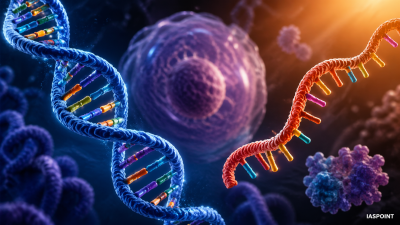
Nucleic acids are the primary information-carrying molecules of all living organisms. They are high molecular weight biopolymers found in the “acid-insoluble fraction” of living tissues. There are two main types of nucleic acids: Deoxyribonucleic Acid (DNA) and Ribonucleic Acid (RNA).
Chemical Composition: The Nucleotides
Nucleic acids are polymers of nucleotides. A single nucleotide is composed of three chemically distinct components:
- A Nitrogenous Base: Heterocyclic compounds containing nitrogen.
- A Pentose Sugar: A five-carbon monosaccharide.
- Phosphoric Acid: Present as a phosphate group (PO43-).
Nitrogenous Bases
There are two categories of nitrogenous bases:
- Purines: Double-ring structures including Adenine (A) and Guanine (G).
- Pyrimidines: Single-ring structures including Cytosine (C), Thymine (T), and Uracil (U).
- Distribution: DNA contains A, G, C, and T. RNA contains A, G, C, and U (Uracil replaces Thymine).
The Pentose Sugar
- Ribose: Found in RNA; it has a hydroxyl group (-OH) at the 2′ carbon.
- 2-Deoxyribose: Found in DNA; it lacks an oxygen atom at the 2′ carbon position, making DNA more chemically stable than RNA.
The Phosphodiester Bond
Nucleotides are linked together by 3’–5′ phosphodiester bonds. The phosphate group connects the 3′ carbon of one sugar molecule to the 5′ carbon of the next. This creates a “sugar-phosphate backbone” from which the nitrogenous bases extend.
Deoxyribonucleic Acid (DNA)
DNA is the genetic material in almost all organisms (except some viruses).
Double Helix Model (Watson and Crick)
In 1953, James Watson and Francis Crick proposed the double helix structure:
- DNA consists of two polynucleotide chains wrapped around each other.
- The two strands run anti-parallel (one in 5′ to 3′ direction, the other in 3′ to 5′).
- Base Pairing Rule (Chargaff’s Rule): Adenine pairs with Thymine (A=T) via two hydrogen bonds. Guanine pairs with Cytosine (G≡C) via three hydrogen bonds.
- The distance between two base pairs is 0.34 nm, and one full turn of the helix contains 10 base pairs (3.4 nm).
Ribonucleic Acid (RNA)
RNA is typically single-stranded and plays a crucial role in protein synthesis and gene regulation. In some viruses (e.g., Retroviruses like HIV), RNA serves as the genetic material.
Major Types of RNA
| Type | Name | Function |
| mRNA | Messenger RNA | Carries the genetic code from DNA to the ribosome. |
| tRNA | Transfer RNA | Acts as an “adapter” molecule to bring amino acids to the ribosome. |
| rRNA | Ribosomal RNA | Forms the structural and catalytic part of the ribosome. |
Comparative Analysis: DNA vs. RNA
| Feature | DNA | RNA |
| Sugar | 2-Deoxyribose | Ribose |
| Nitrogenous Bases | A, G, C, T | A, G, C, U |
| Structure | Double-stranded helix | Usually single-stranded |
| Stability | Highly stable (due to lack of 2′-OH) | Labile/Reactive (easily degraded) |
| Function | Permanent storage of genetic info | Transmission and expression of info |
Biological Significance and Trivia
- Nucleoside vs. Nucleotide: A nucleoside consists only of a nitrogenous base and a sugar. A nucleotide is a “nucleoside phosphate.”
- ATP (Adenosine Triphosphate): ATP is technically a nucleotide (Adenine + Ribose + 3 Phosphates). It is the “energy currency” of the cell.
- Central Dogma: The flow of genetic information follows the path: DNA → RNA → Protein.
- Chargaff’s Rule: In double-stranded DNA, the ratio of Adenine to Thymine and Guanine to Cytosine is always 1:1 (A+G = T+C).
- Ribozymes: Certain RNA molecules possess catalytic activity (like enzymes). This discovery led to the “RNA World” hypothesis, suggesting RNA was the first self-replicating molecule.
- B-DNA: The most common form of DNA found in living cells is the B-form (right-handed helix). Other forms include A-DNA and Z-DNA (left-handed).
UPSC Prelims Fact File
- Mitochondrial DNA (mtDNA): Unlike nuclear DNA, mtDNA is inherited exclusively from the mother. It is circular, resembling bacterial DNA.
- Hydrogen Bonds: The G-C pair is stronger than the A-T pair because it has three hydrogen bonds. Consequently, DNA with high G-C content has a higher melting temperature (Tm).
- Denaturation (Melting): DNA strands can be separated by heating. When cooled, they can “re-anneal” or come back together.
- DNA Fingerprinting: Uses variations in the sequence of nucleotides (specifically non-coding repetitive DNA) to identify individuals.