

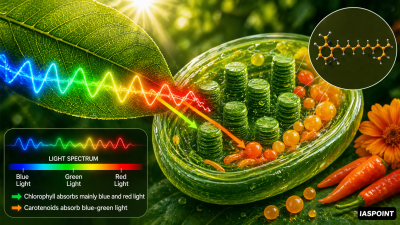
Carotenoids are a group of accessory photosynthetic pigments found in the chloroplasts and chromoplasts of plants, algae, and some bacteria. They are lipid-soluble, organic pigments that typically range in color from yellow and orange to vibrant red. While chlorophyll is the primary pigment for photosynthesis, carotenoids play indispensable secondary roles in energy capture and plant protection.
Classification of Carotenoids
Carotenoids are chemically classified as tetraterpenoids (containing 40 carbon atoms) and are divided into two main categories:
1. Carotenes
- These are pure hydrocarbons (contain only Carbon and Hydrogen).
- β-Carotene: The most common carotene, responsible for the orange color in carrots. It is a precursor to Vitamin A (Retinol) in the human body.
- Lycopene: Found in high concentrations in tomatoes and watermelons, giving them their characteristic red color. It is a potent antioxidant.
2. Xanthophylls
- These are oxygenated derivatives of carotenes (contain Carbon, Hydrogen, and Oxygen).
- Lutein: Found in green leafy vegetables and egg yolks; crucial for human eye health.
- Zeaxanthin: Often found alongside lutein in the retina of the eye.
- Fucoxanthin: Gives brown algae their distinctive color.
Vital Functions of Carotenoids
Accessory Light Harvesting
Carotenoids absorb light in the blue-violet range (wavelengths where chlorophyll is less efficient) and transfer that energy to Chlorophyll-a. This expands the overall “action spectrum” of photosynthesis.
Photoprotection (The “Shield” Function)
This is arguably their most critical role. During intense sunlight, chlorophyll can become over-excited and react with oxygen to form “singlet oxygen”—a highly reactive and damaging free radical. Carotenoids quench this excess energy and dissipate it as heat, preventing the destruction of the photosynthetic apparatus (photo-oxidation).
Reproductive Signaling
By providing bright colors to flowers and fruits in chromoplasts, carotenoids attract pollinators (bees, birds) and seed dispersers (animals), ensuring the continuation of the plant species.
Human Health and Nutrition
| Carotenoid | Dietary Source | Human Health Benefit |
| β-Carotene | Carrots, Sweet Potatoes | Provitamin A; supports immunity and skin health. |
| Lycopene | Tomatoes, Pink Grapefruit | Reduced risk of certain cancers and cardiovascular health. |
| Lutein & Zeaxanthin | Spinach, Kale, Corn | Filters harmful blue light; protects the Macula of the eye. |
| Astaxanthin | Salmon, Shrimp, Microalgae | Extremely powerful antioxidant and anti-inflammatory. |
Comparison: Chlorophyll vs. Carotenoids
| Feature | Chlorophyll | Carotenoids |
| Color | Green | Yellow, Orange, Red |
| Solubility | Lipid-soluble | Lipid-soluble |
| Role | Primary (Reaction Center) | Accessory (Antenna & Protection) |
| Wavelength Absorbed | Blue & Red | Blue-Violet |
| Chemical Element | Contains Nitrogen and Magnesium | Pure hydrocarbons or oxygenated |
UPSC Prelims Fact File and Trivia
- Vitamin A Synthesis: The human liver converts β-carotene into Vitamin A. Deficiency of Vitamin A leads to Night Blindness (Nyctalopia) and Xerophthalmia.
- Golden Rice: A genetically modified (GM) crop engineered to biosynthesize β-carotene in the edible parts of the rice to combat Vitamin A deficiency in developing nations.
- Autumn Foliage: In the fall, deciduous trees stop producing chlorophyll. As the green fades, the more stable carotenoids (which were always present but masked) become visible, resulting in yellow and orange autumn leaves.
- Antioxidant Properties: Carotenoids are highly effective at neutralizing “Free Radicals,” which are linked to aging and cellular damage.
- Animal Pigmentation: Animals cannot synthesize carotenoids. The pink color of flamingos and the orange flesh of salmon come entirely from the carotenoid-rich diets (algae and crustaceans) they consume.