

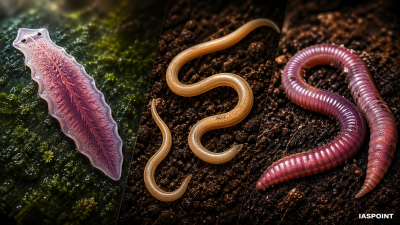
In the biological kingdom Animalia, the term “worms” lacks a single taxonomic rank but spans three distinct phyla: Platyhelminthes (Flatworms), Aschelminthes/Nematoda (Roundworms), and Annelida (Segmented worms). These organisms represent a critical evolutionary transition from simple cellular aggregates to complex organ-system levels of organization.
Phylum Platyhelminthes: The Flatworms
Platyhelminthes are the simplest animals exhibiting bilateral symmetry. They are called “flatworms” because their bodies are dorso-ventrally flattened.
Key Biological Characteristics
- Level of Organization: Organ-level organization.
- Germ Layers: Triploblastic (Ectoderm, Mesoderm, Endoderm).
- Coelom Status: Acoelomate (absence of a body cavity).
- Symmetry: Bilateral symmetry.
- Excretion: Specialized cells called Flame cells (protonephridia) assist in osmoregulation and excretion.
- Digestion: Incomplete digestive system (single opening for mouth and anus).
Notable Classes and Examples
- Turbellaria: Mostly free-living, aquatic worms. Example: Planaria (noted for high regeneration capacity).
- Trematoda: Parasitic flukes. Example: Fasciola hepatica (Liver fluke).
- Cestoda: Endoparasites in the gut of vertebrates. Example: Taenia solium (Pork tapeworm).
Phylum Aschelminthes (Nematoda): The Roundworms
The body of these worms is circular in cross-section, hence the name “roundworms.” They are often found as parasites in plants and animals, causing significant diseases.
Key Biological Characteristics
- Level of Organization: Organ-system level.
- Coelom Status: Pseudocoelomate (body cavity is not lined by mesoderm; instead, mesoderm is present as scattered pouches).
- Digestion: Complete digestive tract with a well-developed muscular pharynx.
- Reproduction: Dioecious (sexes are separate). Often, females are longer than males.
- Symmetry: Bilateral symmetry and triploblastic.
Medical and Agricultural Significance
| Species Name | Common Name | Disease/Impact |
| Ascaris lumbricoides | Roundworm | Ascariasis (Intestinal infection) |
| Wuchereria bancrofti | Filarial worm | Elephantiasis (Filariasis) |
| Ancylostoma duodenale | Hookworm | Anemia and gastrointestinal distress |
| Meloidogyne incognita | Root-knot nematode | Infects roots of tobacco plants |
Phylum Annelida: The Segmented Worms
Annelids represent a major evolutionary leap due to the presence of true segmentation and a closed circulatory system.
Key Biological Characteristics
- Metamerism: The body is externally and internally divided into segments called metameres.
- Coelom Status: True Coelomates (first phylum to evolve a true body cavity).
- Circulation: Closed circulatory system (blood flows through vessels).
- Locomotion: Longitudinal and circular muscles; aquatic annelids like Nereis possess lateral appendages called parapodia for swimming.
- Excretion: Nephridia help in osmoregulation and excretion.
- Nervous System: Paired ganglia connected by lateral nerves to a double ventral nerve cord.
Notable Examples and Facts
- Pheretima (Earthworm): Known as the “Friend of Farmers” for soil aeration and vermicomposting.
- Hirudinaria (Blood-sucking Leech): Produces hirudin, an anticoagulant that prevents blood clotting while feeding.
- Nereis: An aquatic, dioecious annelid, unlike earthworms and leeches which are monoecious (hermaphrodite).
Comparative Analysis for UPSC Prelims
| Feature | Platyhelminthes | Aschelminthes | Annelida |
| Body Shape | Dorso-ventrally flat | Cylindrical | Segmented/Ringed |
| Coelom Type | Acoelomate | Pseudocoelomate | Coelomate |
| Digestive System | Incomplete | Complete | Complete |
| Circulatory System | Absent | Absent | Closed System |
| Excretory Organs | Flame Cells | Canal system/Renette cells | Nephridia |
| Segmentation | Absent (Except Tapeworms) | Absent | Present (Metamerism) |
Evolutionary Trivia and Facts
- The First Triploblasts: Platyhelminthes are the first animals in the evolutionary tree to develop three germ layers, allowing for true organ formation.
- Bilateral Symmetry: This group marks the shift from radial symmetry (like Coelenterates) to bilateral symmetry, which is essential for cephalization (development of a head).
- Regeneration King: Planaria (a flatworm) possesses an incredible ability to regenerate a whole new organism from a small severed piece of its body.
- Parasitic Adaptations: Parasitic flatworms possess hooks and suckers to cling to the host’s internal organs and can absorb nutrients directly through their body surface.