

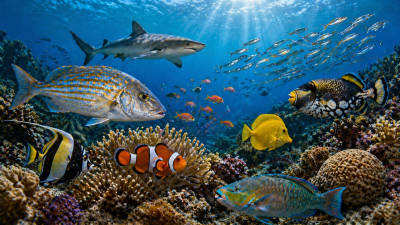
The Class Pisces (Fishes) falls under the Phylum Chordata and Sub-phylum Vertebrata. They are the most diverse group of vertebrates, primarily characterized by their aquatic habitat and streamlined bodies.
- Habitat: Occupy diverse aquatic environments, including freshwater (lakes, rivers), brackish water, and marine (oceans) ecosystems.
- Body Symmetry and Form: Bilaterally symmetrical, usually streamlined (spindle-shaped) to minimize water resistance during locomotion.
- Thermoregulation: Primarily Poikilothermic (Cold-blooded), meaning their internal body temperature fluctuates with the ambient water temperature.
- Locomotion: Facilitated by paired (pectoral and pelvic) and unpaired (dorsal, anal, and caudal) fins. The caudal fin typically provides the primary thrust.
- Respiration: Occurs through gills, which are vascularized structures capable of extracting dissolved oxygen from water.
- Circulatory System: Possess a two-chambered heart (one auricle and one ventricle), exhibiting “single circulation” where blood passes through the heart once per cycle.
- Excretion: Nitrogenous waste is primarily excreted as ammonia (ammonotelic), though some marine fishes excrete urea.
Comparative Analysis: Chondrichthyes vs. Osteichthyes
The Pisces group is broadly divided into two major classes based on their skeletal composition: Chondrichthyes (Cartilaginous fishes) and Osteichthyes (Bony fishes).
| Feature | Chondrichthyes (Cartilaginous) | Osteichthyes (Bony) |
| Endoskeleton | Made of cartilage | Made of bone |
| Mouth Position | Ventral (underside) | Terminal (front end) |
| Gills | 5-7 pairs; lack Operculum (gill cover) | 4 pairs; covered by Operculum |
| Air Bladder | Absent (must swim constantly to avoid sinking) | Present (regulates buoyancy) |
| Scales | Placoid scales (tooth-like) | Cycloid, Ctenoid, or Ganoid scales |
| Fertilization | Mostly Internal | Mostly External |
| Reproduction | Often Viviparous (give birth to live young) | Mostly Oviparous (lay eggs) |
| Examples | Shark, Ray, Skates, Sawfish | Rohu, Katla, Seahorse, Flying fish |
Anatomical and Physiological Adaptations
Integumentary System (Skin and Scales)
The skin of fishes is rich in mucous glands to reduce friction and protect against pathogens. Scales serve as a protective exoskeleton.
- Placoid: Found in sharks; structurally similar to vertebrate teeth.
- Cycloid/Ctenoid: Overlapping scales found in most teleosts (bony fish), allowing for flexibility.
Sensory Organs and the Lateral Line System
A unique feature of fishes is the Lateral Line System, a series of sensory pores running along the sides of the body.
- Function: Detects vibrations, pressure changes, and water currents.
- Significance: Essential for navigation, prey detection, and schooling behavior in low-visibility environments.
Osmoregulation
- Freshwater Fish: Hypertonic to their environment; they constantly gain water by osmosis and lose salts. They excrete large amounts of dilute urine.
- Marine Fish: Hypotonic to their environment; they lose water and gain salts. They drink seawater and excrete highly concentrated urine.
Significant Examples and UPSC Trivia
Common Marine and Freshwater Species
- Exocoetus (Flying Fish): Uses enlarged pectoral fins to glide above the water surface to escape predators.
- Hippocampus (Sea Horse): Known for paternal care where the male carries eggs in a brood pouch.
- Labeo rohita (Rohu): A major Indian carp essential for inland aquaculture.
- Pristis (Sawfish): A cartilaginous fish with a long, flattened rostrum lined with teeth.
Evolutionary Links and “Living Fossils”
- Latimeria (Coelacanth): Often referred to as a “living fossil,” it belongs to the Sarcopterygii (lobe-finned fish) group, which is closely related to the ancestors of tetrapods (four-limbed vertebrates).
- Lungfishes (Dipnoi): Possess both gills and lungs, allowing them to breathe air during dry seasons; they represent an evolutionary bridge between fishes and amphibians.
Biological Importance and Economic Significance
- Nutritional Value: Rich source of Vitamin A, Vitamin D, and Omega-3 fatty acids.
- Bio-control Agents: Species like Gambusia (Mosquito fish) are introduced into water bodies to feed on mosquito larvae, helping control diseases like Malaria and Dengue.
- Environmental Indicators: Fish populations are vital indicators of the health of aquatic ecosystems and water quality.