

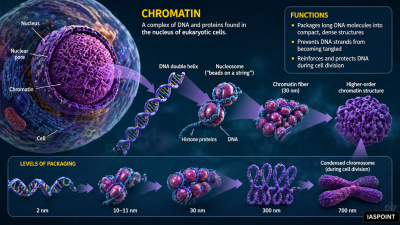
Chromatin is a complex of DNA and proteins found in the nucleus of eukaryotic cells. Its primary function is to package long DNA molecules into more compact, denser structures, preventing the strands from becoming tangled and playing a key role in reinforcing the DNA during cell division.
Structural Composition
Chromatin is not a static structure; it changes its organization throughout the cell cycle.
The Nucleosome (Beads-on-a-String)
The fundamental repeating unit of chromatin is the nucleosome.
- Histone Proteins: DNA winds around a core of eight histone proteins (an octamer). Histones are positively charged, which allows them to bind tightly to the negatively charged phosphate backbone of DNA.
- Linker DNA: The sections of DNA between nucleosomes are called linker DNA, often associated with the H1 histone, which helps stabilize the structure.
Levels of Compaction
- 10 nm Fiber: The “beads-on-a-string” appearance.
- 30 nm Fiber: The nucleosomes coil into a thicker fiber (solenoid structure).
- Chromosomes: During the metaphase of cell division, chromatin reaches its highest level of condensation to form distinct chromosomes.
Types of Chromatin
Based on the degree of packing and genetic activity, chromatin is divided into two functional types:
| Feature | Euchromatin | Heterochromatin |
| Packing | Loosely packed | Tightly/Densely packed |
| Staining | Stains light | Stains dark |
| Transcription | Genetically active (RNA synthesis occurs) | Genetically inactive (Silenced genes) |
| Location | Found towards the interior of the nucleus | Often found at the periphery or centromeres |
Functions of Chromatin
- DNA Packaging: Compresses roughly 2 meters of DNA into a nucleus only a few micrometers in diameter.
- Transcription Regulation: By tightening or loosening its structure (remodeling), chromatin controls which genes are accessible to be read and expressed.
- Protection: Prevents DNA damage by hiding the strands within a protein-reinforced structure.
- Cell Division Coordination: Ensures that DNA is accurately segregated into daughter cells by condensing into manageable chromosome units.
Chemical Modifications (Epigenetics)
The behavior of chromatin is regulated by chemical changes to the histone tails:
- Acetylation: Usually associated with “turning on” genes (loosening chromatin).
- Methylation: Can either activate or repress genes depending on the specific location of the methyl group.
Facts for UPSC Prelims
- Non-Histone Proteins: While histones are the structural core, chromatin also contains non-histone chromosomal (NHC) proteins required for higher-level packaging and gene regulation.
- Discovery: The term “chromatin” was coined by Walther Flemming in 1879 due to the material’s affinity for dyes (Chroma = color).
- Prokaryotic Exception: Prokaryotes (like bacteria) do not have true chromatin. Their DNA is “naked” and found in a region called the nucleoid, though it is associated with some basic proteins.
- Barr Body: In female mammals, one of the two X chromosomes is inactivated and highly condensed into heterochromatin, visible as a dark spot called a Barr Body.
- Dynamic Nature: Chromatin is most dispersed during Interphase (when the cell is growing and copying DNA) and most condensed during M-phase (Mitosis).