

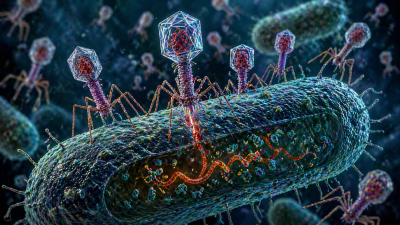
Bacteriophages, commonly referred to as phages, are a specific category of viruses that infect and replicate within bacteria. The term literally translates to “bacteria eater.” They are among the most common and diverse entities in the biosphere and play a critical role in maintaining microbial balance in various ecosystems.
Structural Composition
The most well-studied bacteriophages, such as the T-even phages (T2, T4), exhibit a complex “tadpole-like” symmetry.
- Head: A polyhedral (icosahedral) protein capsid that encloses the genetic material.
- Genetic Material: Usually double-stranded DNA (dsDNA), though some rare phages may contain ssDNA, ssRNA, or dsRNA.
- Tail: A hollow helical tube (sheath) through which the nucleic acid is injected into the bacterial host.
- Base Plate and Tail Fibers: Located at the bottom of the tail, these structures are essential for recognizing and attaching to specific receptor sites on the bacterial cell wall.
The Life Cycle of a Bacteriophage
Bacteriophages reproduce through two primary mechanisms: the Lytic Cycle and the Lysogenic Cycle.
The Lytic Cycle (Virulent Infection)
- Attachment: Phage tail fibers bind to specific receptors on the bacterial surface.
- Penetration: The phage injects its DNA into the bacterial cell; the empty protein coat (ghost) remains outside.
- Biosynthesis: The host’s metabolic machinery is hijacked to produce viral DNA and proteins.
- Maturation: New phage particles are assembled.
- Lysis: The bacterial cell wall ruptures, releasing hundreds of new phages to infect neighboring cells.
The Lysogenic Cycle (Temperate Infection)
- Integration: The viral DNA is integrated into the bacterial chromosome, becoming a Prophage.
- Replication: The prophage remains latent and is replicated along with the bacterial DNA during normal cell division.
- Induction: Under environmental stress (like UV radiation), the prophage may exit the bacterial chromosome and enter the lytic cycle.
Ecological and Historical Significance
The “Ganga” Phenomenon
A recurring topic in Indian science and ecology is the self-purifying property of the River Ganga.
- Fact: Research has attributed this to a high concentration of specialized bacteriophages (specifically Bdellovibrio) that target and destroy pathogenic bacteria like Vibrio cholerae and E. coli.
- Significance: These phages help maintain the water quality even when high organic loads are present.
Phage Therapy
With the rise of Antimicrobial Resistance (AMR) and “Superbugs,” Phage Therapy has regained global interest.
- Mechanism: Using specific phages to target and kill multi-drug resistant (MDR) bacteria.
- Advantage: Unlike broad-spectrum antibiotics, phages are highly specific and do not harm the beneficial gut microbiota.
Comparison: Bacteriophage vs. Animal Virus
| Feature | Bacteriophage | Animal Virus |
|---|---|---|
| Host | Bacteria | Animals/Humans |
| Entry Method | Injection of nucleic acid | Endocytosis or Fusion of envelope |
| Site of Synthesis | Cytoplasm | Nucleus or Cytoplasm |
| Genetic Material | Predominantly dsDNA | DNA or RNA (ss/ds) |
Quick Facts for UPSC Prelims
- Discovery: Independently discovered by Frederick Twort (1915) and Félix d’Hérelle (1917).
- Transduction: Bacteriophages are agents of horizontal gene transfer in bacteria through a process called transduction, where they accidentally carry bacterial DNA from one cell to another.
- Biotechnology Tool: Phages are used as vectors in genetic engineering and for “phage display” technology (used to study protein interactions, which won a Nobel Prize in Chemistry in 2018).
- Size: They are much smaller than their bacterial hosts, typically ranging from 24 to 200 nanometers in length.