

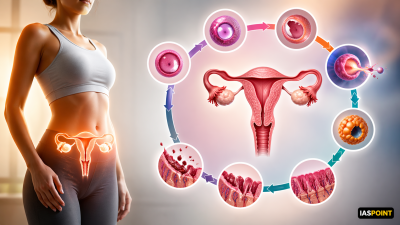
The menstrual cycle is a series of natural changes in the production of hormones and the structures of the uterus and ovaries of the female reproductive system. It is characteristic of female primates (including humans, apes, and monkeys).
- Menarche: The first occurrence of menstruation, typically marking the onset of puberty.
- Menopause: The permanent cessation of the menstrual cycle, usually occurring between ages 45 and 55.
- Duration: The average length is 28 days, though variations between 21 to 35 days are considered normal.
Phases of the Menstrual Cycle
The cycle is divided into four distinct phases based on changes in the ovary (Ovarian Cycle) and the uterus (Uterine Cycle).
1. Menstrual Phase (Days 1–5)
This phase occurs when fertilization has not taken place.
- Trigger: A sharp decline in progesterone and estrogen levels due to the degeneration of the corpus luteum.
- Action: The endometrial lining of the uterus breaks down along with its blood vessels.
- Output: Blood and mucosal tissue (menses) are discharged through the vagina.
2. Follicular / Proliferative Phase (Days 6–13)
This phase involves the preparation for ovulation and potential pregnancy.
- Ovarian Changes: Under the influence of Follicle Stimulating Hormone (FSH), primary follicles in the ovary grow to become fully mature Graafian follicles.
- Uterine Changes: The endometrium of the uterus regenerates through proliferation, stimulated by rising levels of estrogen secreted by the growing follicles.
3. Ovulatory Phase (Day 14)
This is the most fertile period of the cycle.
- LH Surge: Both LH and FSH reach a peak level in the middle of the cycle. A rapid increase in Luteinizing Hormone (LH) induces the rupture of the Graafian follicle.
- Action: The release of the secondary oocyte (ovum) into the pelvic cavity.
4. Luteal / Secretory Phase (Days 15–28)
This phase prepares the body for the implantation of a fertilized egg.
- Corpus Luteum: The remaining parts of the ruptured Graafian follicle transform into a yellow endocrine structure called the Corpus Luteum.
- Progesterone Secretion: The corpus luteum secretes large amounts of progesterone, which is essential for maintaining the thick, glandular endometrium.
- In Absence of Fertilization: The corpus luteum degenerates into the Corpus Albicans, progesterone levels drop, and the cycle repeats with menstruation.
Summary of Hormonal Regulation
The cycle is a feedback loop involving the hypothalamus, anterior pituitary, and ovaries.
| Hormone | Source | Primary Role in Cycle |
| GnRH | Hypothalamus | Stimulates the pituitary to release FSH and LH. |
| FSH | Anterior Pituitary | Stimulates follicle growth and estrogen secretion. |
| LH | Anterior Pituitary | Triggers ovulation and develops the corpus luteum. |
| Estrogen | Ovarian Follicles | Heals/thickens the endometrium; inhibits FSH (low levels). |
| Progesterone | Corpus Luteum | Maintains the endometrium; inhibits LH and FSH. |
Comparison: Ovarian vs. Uterine Events
| Phase | Ovarian Event | Uterine Event | Main Hormone |
| Menstrual | Primary follicle starts developing | Endometrial shedding | Low Progesterone |
| Proliferative | Follicle Maturation | Endometrial Repair | Estrogen |
| Ovulatory | Rupture of Graafian Follicle | High receptivity | LH (Surge) |
| Secretory | Formation of Corpus Luteum | Endometrium thickens | Progesterone |
UPSC Prelims Fact Sheet: Menstrual Cycle
- Fertile Window: Typically considered between Day 10 and Day 17 of the cycle, as sperm can survive in the female tract for up to 5 days and the ovum for 24 hours.
- Amenorrhea: The absence of menstruation. It can be a “normal” indicator of pregnancy or lactation, or a “pathological” indicator of stress, poor nutrition, or hormonal imbalance.
- Lactational Amenorrhea: During intense breastfeeding, ovulation and the cycle do not occur. It serves as a natural (though not 100% reliable) contraceptive method for up to 6 months post-childbirth.
- Role of Inhibin: Secreted by the granulosa cells of the follicle, it provides negative feedback to the pituitary to decrease FSH, ensuring usually only one follicle reaches maturity.
- Body Temperature: Basal body temperature slightly increases (approx. 0.5°C) immediately after ovulation due to the thermogenic effect of progesterone.