

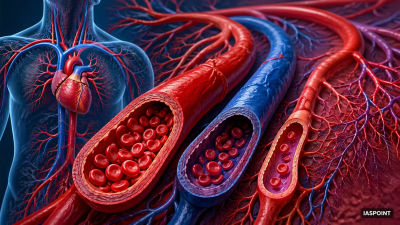
Blood vessels are the intricate network of “pipes” that transport blood throughout the human body. In the Closed Circulatory System of humans, blood is confined to these vessels, which prevents the direct mixing of blood with interstitial fluid. The three primary types of vessels are Arteries, Veins, and Capillaries, each structurally adapted to its specific physiological role.
Histology: The Three Layers of Vessel Walls
Except for capillaries, all blood vessels consist of three distinct layers of tissue:
- Tunica Interna (Intima): The innermost layer composed of a thin layer of squamous endothelium. It provides a smooth surface to minimize friction.
- Tunica Media: The middle layer consisting of smooth muscles and elastic fibers. It is significantly thicker in arteries to withstand high pressure.
- Tunica Externa (Adventitia): The outermost layer made of fibrous connective tissue with collagen fibers, providing structural integrity.
Arteries: The Distributing Vessels
Arteries carry blood away from the heart to various organs and tissues.
- Pressure: They carry blood under high pressure, hence they have thick, elastic walls.
- Lumen: They possess a narrow lumen compared to veins.
- Oxygenation: They carry oxygenated blood, with the Pulmonary Artery being the sole exception (it carries deoxygenated blood to the lungs).
- Valves: Arteries do not have valves because the high pressure of blood from the heart prevents backflow.
- Arterioles: These are the smallest branches of arteries that lead into capillaries; they are the primary site of vascular resistance.
Veins: The Collecting Vessels
Veins carry blood toward the heart from the organs and tissues.
- Pressure: They carry blood under much lower pressure, resulting in thinner walls with less muscular tissue.
- Lumen: They have a wide lumen to act as blood reservoirs.
- Oxygenation: They carry deoxygenated blood, with the Pulmonary Vein being the sole exception (it carries oxygenated blood from the lungs).
- Valves: Veins contain semilunar valves to ensure blood flows in one direction (toward the heart) and to prevent backflow due to gravity.
- Venules: Small vessels that gather blood from the capillaries and unite to form veins.
Capillaries: The Exchange Vessels
Capillaries are microscopic vessels that connect arterioles to venules. They are the most numerous vessels in the body.
- Wall Structure: Their walls are only one cell thick, consisting solely of the Tunica Interna (endothelium).
- Function: This extreme thinness allows for the diffusion of gases (O2 and CO2), nutrients (glucose, amino acids), and metabolic wastes between the blood and the surrounding tissue fluid.
- Surface Area: They provide a massive surface area for exchange, though the flow of blood through them is very slow to allow time for diffusion.
Comparison of Arteries, Veins, and Capillaries
| Feature | Arteries | Veins | Capillaries |
| Direction of Flow | Away from the Heart | Toward the Heart | Arterioles to Venules |
| Blood Pressure | Very High | Low | Very Low |
| Wall Thickness | Thick and Elastic | Thin and Less Elastic | Extremely Thin (Single layer) |
| Lumen Size | Narrow | Wide | Microscopic |
| Valves | Absent | Present | Absent |
| Primary Function | Distribution | Collection | Exchange of materials |
Specialized Vascular Systems
- Coronary Vessels: A special system of blood vessels (Coronary Arteries and Veins) dedicated exclusively to the circulation of blood to and from the cardiac musculature.
- Hepatic Portal System: A unique vascular connection between the digestive tract and the liver. The Hepatic Portal Vein carries blood from the intestine to the liver before it is delivered to the systemic circulation, allowing the liver to process absorbed nutrients.
Important Facts for UPSC Prelims
- Aorta: The largest artery in the human body, originating from the left ventricle.
- Vena Cava: The largest veins; the Superior Vena Cava drains the head and arms, while the Inferior Vena Cava drains the lower body.
- Varicose Veins: A condition where the valves in the veins (usually in the legs) fail, causing blood to pool and the veins to become enlarged and twisted.
- Blood Pressure Measurement: Arterial blood pressure is measured using a Sphygmomanometer, typically using the brachial artery in the arm.
- Vasoconstriction & Vasodilation: The Tunica Media allows vessels to contract or expand to regulate blood flow and body temperature, a process controlled by the Autonomic Nervous System.