

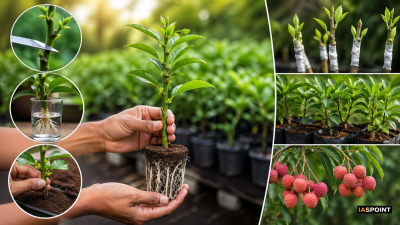
Artificial vegetative propagation involves man-made methods used to multiply plants using their vegetative parts (roots, stems, or leaves). These techniques are vital in horticulture and agriculture for producing “clones”—plants that are genetically identical to the parent—ensuring the preservation of superior traits like fruit quality, disease resistance, and high yield.
Principal Methods of Artificial Propagation
Human intervention utilizes the natural regenerative capacity of plant tissues to create new individuals.
1. Cutting
This is the simplest and most common method where a portion of the plant is removed and placed in a medium (soil or water) to develop roots and shoots.
- Stem Cutting: A piece of the stem with nodes is planted.
- Examples: Sugarcane, Rose, China Rose (Hibiscus), Grapes, and Coffee.
- Root Cutting: Used for plants that naturally produce suckers.
- Examples: Lemon, Tamarind, and Blackberry.
- Leaf Cutting: Common in succulents.
- Example: Sanservieria (Snake plant).
2. Layering
In this method, roots are induced on a stem while it is still attached to the parent plant. This ensures the “layer” receives water and nutrients during the rooting process.
- Mound Layering: The lower branch of a plant is bent to the ground and covered with moist soil, leaving the tip exposed.
- Examples: Jasmine, Strawberry, and Raspberry.
- Air Layering (Gootee): Used for plants with thick branches that cannot be bent. The bark is removed in a ring, covered with grafting clay or moss, and wrapped in polythene.
- Examples: Litchi, Pomegranate, Orange, and Guava.
3. Grafting
Grafting involves joining the parts of two different plants so that they grow as a single plant. This is the preferred method for high-quality fruit trees.
- Stock: The rooted portion of the plant (often selected for a strong root system or disease resistance).
- Scion: The shoot portion of the plant (selected for superior fruit or flower quality).
- Process: The cambium layers of both stock and scion must be in close contact for vascular tissues to fuse.
- Examples: Mango, Citrus fruits, Apple, Rubber, and Rose.
4. Micropropagation (Plant Tissue Culture)
A modern biotechnological method where plant cells, tissues, or organs are grown in a sterile nutrient medium under controlled laboratory conditions.
- Explant: The specific plant part (like a leaf segment or root tip) used to initiate the culture.
- Callus: An undifferentiated mass of cells formed during the process.
- Totipotency: The unique biological property of a plant cell to develop into a complete plant.
- Advantages: Rapid multiplication, production of virus-free plants (via meristem culture), and year-round propagation.
- Examples: Banana, Orchards, Tomato, and Potato.
Comparative Analysis of Artificial Methods
| Method | Key Mechanism | Best Suited For |
| Cutting | Regeneration from detached parts | Sugarcane, Rose, Bougainvillea |
| Layering | Rooting while attached to parent | Jasmine, Lemon, Pomegranate |
| Grafting | Combining two different plants | Mango, Apple, Citrus |
| Tissue Culture | Laboratory-based cellular growth | Banana, Orchids, Disease-free clones |
Advantages for Agriculture and Horticulture
- Seedless Plants: It is the only way to propagate plants that do not produce viable seeds, such as Seedless Grapes, Bananas, and Pineapples.
- Uniformity: Since offspring are clones, the entire crop matures at the same time and produces uniform quality, which is essential for commercial exports.
- Rapid Maturity: Vegetatively propagated plants usually flower and bear fruit much earlier than those grown from seeds.
- Disease Management: Through meristem culture (using the tip of the shoot), scientists can produce virus-free clones even from an infected parent plant.
UPSC Prelims Trivia: Fact Check
- Cambium Contact: In grafting, the most critical requirement is the alignment of the Vascular Cambium. Without this, the stock and scion will not fuse.
- Monocots vs. Dicots: Grafting is generally successful in Dicots because they possess a vascular cambium. It is difficult or impossible in Monocots (like Bamboo or Palms) because their vascular bundles are scattered and lack a cambium layer.
- Somaclonal Variation: While micropropagation aims for identical clones, sometimes genetic variations occur during tissue culture; these are called Somaclones.