

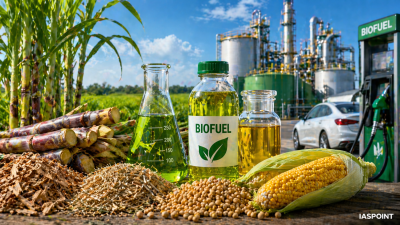
Biofuels are liquid, solid, or gaseous fuels produced from biomass—organic matter derived from plants, agricultural waste, animal waste, and industrial byproducts.
Generations of Biofuels
Biofuels are classified into four generations based on the source of biomass and the technological complexity involved in their production.
| Generation | Feedstock Source | Key Characteristics | Examples |
| 1st Generation | Edible food crops (Sugar, Starch, Vegetable oils) | Direct fermentation or extraction; competes with food security. | Ethanol from sugarcane/corn; Biodiesel from soybean. |
| 2nd Generation | Non-edible biomass (Cellulose, Lignin, Agri-residue) | Uses lignocellulosic biomass like husks, stalks, and wood chips. | Ethanol from rice straw, corn cobs, or bamboo. |
| 3rd Generation | Algal biomass (Microalgae/Macroalgae) | High yield; can be grown on non-arable land or wastewater. | Algal oil, Biodiesel from lipids in algae. |
| 4th Generation | Genetically Modified (GM) Organisms | Uses carbon capture and GM microbes/algae to enhance efficiency. | Photobiological solar fuels, Carbon-negative biofuels. |
Major Types of Biofuels
1. Bioethanol
- Production: Produced primarily through the fermentation of sugars or starches by microorganisms like yeast (Saccharomyces cerevisiae).
- Process: For 2G ethanol, the process involves “Pre-treatment” to break down lignin, “Enzymatic Hydrolysis” to convert cellulose into sugar, and “Fermentation.”
- Application: Primarily used as a petrol additive.
2. Biodiesel
- Production: Produced from vegetable oils, waste cooking oil, or animal fats through a chemical process called Transesterification.
- Chemical Fact: It involves reacting lipids (fats/oils) with an alcohol (typically methanol) in the presence of a catalyst to produce fatty acid methyl esters (FAME).
- Source in India: Non-edible oilseeds like Jatropha curcas and Karanja (Pongamia pinnata).
3. Biogas and Bio-CNG
- Production: Produced through the Anaerobic Digestion (breakdown in the absence of oxygen) of organic matter.
- Composition: Primarily Methane (CH4) and Carbon Dioxide (CO2), with traces of Hydrogen Sulfide.
- Purification: When biogas is purified to remove CO2 and H2S, it becomes Bio-CNG (Compressed Biogas), which has over 90% methane content.
Biotechnological Interventions
Biotechnology plays a pivotal role in making biofuel production commercially viable and efficient.
- Enzyme Engineering: Development of high-efficiency cellulase enzymes to break down tough plant cell walls in 2G biofuels.
- Metabolic Engineering: Modifying the metabolic pathways of bacteria (e.g., E. coli) or yeast to increase their tolerance to high alcohol concentrations and improve yield.
- Synthetic Biology: Creating “Designer Algae” with higher lipid (oil) content for 3rd generation biofuel production.
India’s Policy and Regulatory Framework
National Policy on Biofuels, 2018 (Amended 2022)
- Categorization: Categorizes biofuels as “Basic Biofuels” (1G) and “Advanced Biofuels” (2G, 3G) to allow appropriate incentives.
- Blending Targets: The Government of India set a target of 20% blending of ethanol in petrol (E20) by 2025-26 (advanced from the original 2030 goal).
- Feedstock Expansion: Allows use of surplus food grains (maize, rice from FCI) and damaged food grains for ethanol production.
Key Initiatives
- EBP Programme: Ethanol Blended Petrol Programme.
- SATAT Scheme: (Sustainable Alternative Towards Affordable Transportation) Aims to set up Compressed Bio-Gas (CBG) production plants and make them available in the market for use in automotive fuels.
- PM-JI-VAN Yojana: (Pradhan Mantri JI-VAN Yojana) Provides financial support to Integrated Bioethanol Projects using lignocellulosic biomass (2G).
- GOBAR-dhan Scheme: (Galvanizing Organic Bio-Agro Resources dhan) Focuses on managing and converting cattle dung and solid waste in farms to CBG and compost.
Technical Facts for Prelims
Energy Content
Bioethanol has lower energy density than petrol (about 34% less), meaning more fuel is required to travel the same distance. However, it has a higher octane rating, which improves engine performance and prevents “knocking.”
The Food vs. Fuel Debate
This refers to the dilemma regarding the risk of diverting farmland or crops for biofuels to the detriment of the food supply. This is a primary reason why India is shifting focus toward 2G (Agri-waste) and 3G (Algae) biofuels.
Syngas (Synthesis Gas)
A mixture of Carbon Monoxide (CO), Hydrogen (H2), and sometimes CO2. It is produced by gasification of biomass and can be converted into liquid fuels through the Fischer-Tropsch process.
Drop-in Fuels
These are liquid bio-hydrocarbons that are completely interchangeable with conventional fuels. Unlike ethanol, which requires engine modifications for high blending levels, drop-in fuels require no change in engine design or fuel infrastructure.
Last Modified: May 7, 2026