

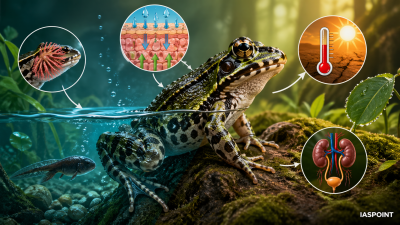
The physiology of amphibians is defined by their “double life,” requiring systems that function effectively in both aquatic and terrestrial environments. Their survival depends on high skin permeability, ectothermic temperature regulation, and complex water-electrolyte balance.
1. Respiration: The Tri-modal System
Amphibians are unique in their ability to use multiple surfaces for gas exchange, often switching between them based on environmental conditions and activity levels.
- Cutaneous Respiration:
- Mechanism: Oxygen and carbon dioxide exchange directly through the moist, vascularized skin.
- Requirement: The skin must remain wet; if it dries, the animal may suffocate.
- Efficiency: During hibernation (winter sleep) or aestivation (summer sleep), this becomes the sole source of oxygen.
- Buccopharyngeal Respiration:
- Occurs through the moist lining of the mouth and pharynx.
- The floor of the mouth is rhythmically lowered and raised to pump air over the mucosal membranes.
- Pulmonary Respiration:
- Used during periods of high activity (e.g., jumping or calling).
- Positive Pressure Breathing: Since they lack a diaphragm and ribs, they use “buccal pumping.” They take air into the mouth, close the nostrils, and raise the floor of the mouth to force air into the lungs.
- Branchial Respiration:
- Exclusively used by larvae (tadpoles) and neotenic adults (e.g., Axolotls) via external or internal gills.
2. Circulatory Dynamics
Amphibians possess a closed circulatory system with double circulation (Pulmonary and Systemic circuits).
- Heart Anatomy: A three-chambered heart consisting of two atria and one ventricle.
- Blood Mixing: While the ventricle is single, mixing of oxygenated and deoxygenated blood is minimized by the Spiral Valve in the conus arteriosus, which directs blood flow based on pressure differences.
- RBC Characteristics: Amphibian Red Blood Cells are nucleated, oval, and generally larger than those of mammals.
- Lymphatic System: Highly developed in amphibians; they possess “lymph hearts” that pump lymph back into the venous system.
3. Thermoregulation: Ectothermy
Amphibians are Poikilothermic (cold-blooded), meaning their internal body temperature fluctuates with the environment.
- Behavioral Thermoregulation: They move between sun and shade or water and land to maintain optimal temperatures.
- Metabolic Depression: To survive extreme temperatures, they enter states of dormancy:
- Hibernation: Winter dormancy in mud or burrows.
- Aestivation: Summer dormancy to avoid desiccation (drying out).
4. Excretion and Osmoregulation
The physiological challenge for amphibians is maintaining salt balance while living in water (where they gain water by osmosis) or on land (where they lose it via evaporation).
- Nitrogenous Waste:
- Ammonotelic: Aquatic larvae excrete toxic ammonia, which requires large amounts of water for dilution.
- Ureotelic: Terrestrial adults convert ammonia to urea, which is less toxic and conserves water.
- Water Balance: Amphibians do not “drink” water in the traditional sense; they absorb it through a “pelvic patch” of highly permeable skin on their underside.
- Kidney Function: They possess mesonephric kidneys. In water, they produce large volumes of dilute urine to expel excess water. On land, they reabsorb water from the urinary bladder.
5. Nervous System and Sensory Physiology
- Vision: Most have excellent vision. The nictitating membrane acts as a “clear eyelid” to protect the eye underwater.
- Hearing: The Tympanum (eardrum) picks up sound waves. In many species, the lungs also act as secondary resonators to help the animal distinguish its own calls from others.
- Chemoreception: The Vomeronasal organ (Jacobson’s organ) is well-developed for sensing chemical signals/pheromones in the air or water.
Comparison: Physiological States
| Process | Aquatic Stage (Tadpole) | Terrestrial Stage (Adult) |
| Main Respiratory Organ | Gills | Lungs and Skin |
| Nitrogenous Waste | Ammonia | Urea |
| Heart Structure | 2-chambered (initially) | 3-chambered |
| Feeding Physiology | Mostly Herbivorous (Filter feeders) | Carnivorous (Predatory) |
| Vision | Adapted for refractive index of water | Adapted for aerial vision |
Trivia for UPSC Prelims
- Freeze Tolerance: Some species, like the Wood Frog, can survive the freezing of their body fluids by producing high concentrations of glucose/urea that act as a natural “antifreeze.”
- Skin Molting: Amphibians periodically shed their outer skin (ecdysis), and many species consume the shed skin (dermatophagy) to recycle nutrients.
- Vocal Sacs: Only male frogs typically possess vocal sacs, which act as resonators to amplify mating calls during the breeding season.