

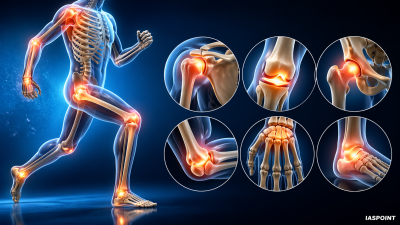
Joints, also known as articulations, are the points of contact between two bones, between bone and cartilage, or between teeth and bones. They are essential for mobility and provide structural stability.
Structural Classification of Joints
This classification is based on the material binding the bones together and the presence or absence of a joint cavity.
Fibrous Joints (Immovable)
Bones are joined by dense fibrous connective tissue. There is no joint cavity, and they allow little to no movement (Synarthrosis).
- Sutures: Found only between the bones of the Skull. In adults, these ossify to form a single unit.
- Syndesmoses: Bones connected by ligaments (e.g., the distal joint between the Tibia and Fibula).
- Gomphoses: The “peg-in-socket” fibrous joint between a tooth and its alveolar socket in the jaw.
Cartilaginous Joints (Slightly Movable)
Bones are united by cartilage. They lack a joint cavity and allow limited movement (Amphiarthrosis).
- Synchondroses: Connected by hyaline cartilage (e.g., Epiphyseal plates in growing long bones).
- Symphyses: Connected by fibrocartilage, which acts as a shock absorber (e.g., Intervertebral discs and the Pubic symphysis).
Synovial Joints (Freely Movable)
Bones are separated by a fluid-filled joint cavity. These are the most common joints in the body and allow a wide range of movement (Diarthrosis).
- Key Features: Articular cartilage, Joint (Synovial) cavity, Articular capsule, and Synovial fluid (lubricant derived from blood filtration).
Types of Synovial Joints
Synovial joints are further categorized based on the shape of the articulating surfaces and the planes of movement allowed.
| Joint Type | Mechanism of Movement | Examples |
| Ball and Socket | Provides greatest range of motion (multiaxial). | Shoulder and Hip joints. |
| Hinge Joint | Permits movement in one plane only (uniaxial), like a door. | Elbow, Knee, and Interphalangeal joints. |
| Pivot Joint | Allows rotation around a central axis. | Atlas/Axis (neck rotation) and Proximal Radioulnar joint. |
| Gliding (Plane) | Flat surfaces slide over one another. | Intercarpal (wrist) and Intertarsal (ankle) bones. |
| Saddle Joint | Each surface has concave and convex areas (biaxial). | Carpometacarpal joint of the Thumb. |
| Condyloid (Ellipsoid) | Oval-shaped end of one bone fits into an oval cavity. | Wrist joint (between Radius and Carpals). |
Functional Classification of Joints
UPSC often uses these terms to describe the degree of movement permitted:
- Synarthrosis: Immovable joints (mostly fibrous).
- Amphiarthrosis: Slightly movable joints (mostly cartilaginous).
- Diarthrosis: Freely movable joints (all synovial joints).
Movements Permitted by Joints
- Flexion and Extension: Decreasing or increasing the angle between bones (e.g., bending the elbow).
- Abduction and Adduction: Moving a limb away from or toward the midline of the body.
- Circumduction: Moving a limb so that it describes a cone in space.
- Rotation: Turning of a bone around its own long axis.
Critical Facts for UPSC Prelims
- Knee Joint: The largest and most complex joint in the human body.
- Synovial Fluid: Contains hyaluronic acid, which reduces friction between the articular cartilages.
- Ligaments vs. Tendons: Ligaments reinforce synovial joints by connecting bone to bone; tendons connect muscle to bone to facilitate movement.
- Bursae: Small fluid-filled sacs located around joints to reduce friction between skin/tendons and bones.
Clinical Correlations and Disorders
- Dislocation (Luxation): Occurs when bones are forced out of alignment at a joint.
- Sprain: Stretching or tearing of ligaments reinforcing a joint.
- Arthritis: A broad term for over 100 types of joint inflammation.
- Osteoarthritis: “Wear-and-tear” arthritis where articular cartilage softens and erodes.
- Rheumatoid Arthritis: An autoimmune disease where the body’s immune system attacks the synovial membrane.
- Bursitis: Inflammation of a bursa usually caused by a blow or friction.