

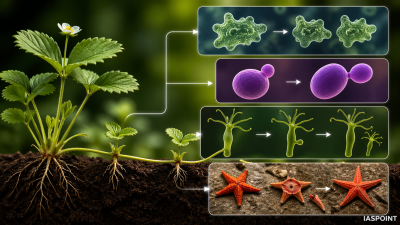
Asexual reproduction is a biological process where offspring are produced from a single parent without the fusion of gametes or changes in the number of chromosomes.
Natural Methods of Asexual Reproduction
Plants have evolved various specialized structures to survive unfavorable conditions and propagate without seeds. This is often referred to as Vegetative Propagation.
Modified Underground Stems
Many plants store food in underground stems which also act as organs of perennation.
- Tubers: Swollen ends of underground branches containing “eyes” (axillary buds). Example: Potato (Solanum tuberosum).
- Rhizomes: Prostrate, thickened stems growing horizontally. Example: Ginger, Turmeric, Lotus.
- Bulbs: Highly reduced stems surrounded by fleshy scale leaves. Example: Onion, Garlic.
- Corms: Unbranched, swollen vertical stems. Example: Colocasia, Zaminkand.
Sub-aerial and Aerial Modifications
- Runners: Long, slender horizontal stems that grow along the soil surface. Example: Grass (Cynodon), Oxalis.
- Offsets: Short, horizontal branches found in aquatic plants. Example: Pistia, Water Hyacinth (Eichhornia crassipes – known as the “Terror of Bengal”).
- Suckers: Arise from the underground portion of the stem. Example: Chrysanthemum, Mint.
- Bulbils: Fleshy vegetative buds that detach to form new plants. Example: Agave, Dioscorea.
Reproduction via Leaves and Roots
- Leaves: Certain plants develop adventitious buds along leaf margins. Example: Bryophyllum, Begonia.
- Roots: Adventitious buds on fleshy roots can develop into new plants. Example: Sweet Potato, Dahlia, Guava.
Comparison of Vegetative Propagules
| Propagule Type | Botanical Structure | Key Examples |
| Runner | Sub-aerial Stem | Lawn Grass, Strawberry |
| Rhizome | Underground Stem | Ginger, Banana, Canna |
| Tuber | Underground Stem Tip | Potato |
| Offset | Lateral Branch (Aquatic) | Water Hyacinth, Pistia |
| Bulbil | Modified Floral Bud | Agave |
| Foliar Buds | Leaf Margins | Bryophyllum |
Artificial Methods of Vegetative Propagation
These methods are widely used in agriculture and horticulture to maintain desirable genetic traits (clones).
Cutting, Layering, and Grafting
- Cutting: A portion of the stem, root, or leaf is placed in moist soil. Example: Rose, Sugarcane, China rose.
- Layering: A branch is lowered to the ground and covered with soil while still attached to the parent. Example: Jasmine, Lemon.
- Grafting: Joining parts of two different plants (the Stock or rooted part and the Scion or the shoot part) to grow as one. This is common in fruit trees like Mango, Citrus, and Apple.
Micropropagation (Tissue Culture)
This involves growing plant cells or tissues in a sterile nutrient medium under controlled conditions.
- Explants: Any part of the plant taken out and grown in a test tube.
- Totipotency: The capacity of a cell/explant to generate a whole plant.
- Somaclones: Plants chemically and genetically identical to the original plant.
- Applications: Rapid multiplication of orchids, banana, and tomato; recovering healthy plants from diseased ones (using meristem culture).
Specialized Modes: Apomixis and Polyembryony
These topics are frequent in UPSC biology questions due to their unique evolutionary advantages.
Apomixis
Apomixis is a form of asexual reproduction that mimics sexual reproduction but produces seeds without fertilization.
- Mechanism: The diploid egg cell is formed without reduction division and develops into an embryo without fertilization.
- Significance: It is used in the hybrid seed industry to prevent the segregation of desirable characters in hybrid varieties, allowing farmers to reuse seeds.
- Common Families: Asteraceae and Poaceae (Grasses).
Polyembryony
The occurrence of more than one embryo in a seed is referred to as polyembryony.
- Occurrence: Frequently observed in Citrus fruits and Mango.
- Source: Nucellar cells surrounding the embryo sac start dividing, protrude into the embryo sac, and develop into embryos.
Facts and Trivia for UPSC Prelims
- Terror of Bengal: Eichhornia crassipes (Water Hyacinth) was introduced in India for its beautiful flowers but became an invasive weed that drains oxygen from water bodies, leading to fish mortality. It propagates phenomenally fast via offsets.
- Clonal Nature: Offspring produced asexually are morphologically and genetically identical, termed as a clone.
- Meristem Culture: Even if a plant is infected with a virus, the meristem (apical and axillary) is free of virus. This is used to produce virus-free plants via tissue culture.
- Agamospermy: A synonym for apomixis where seeds are produced without the sexual process.