

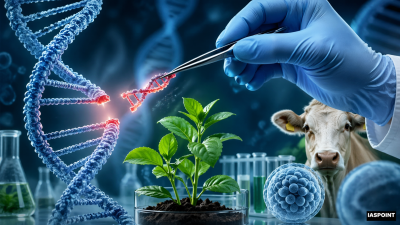
Genetic engineering, also known as Recombinant DNA Technology, is a sophisticated technique of biotechnology used to alter the genetic makeup of an organism. It involves the direct manipulation of one or more genes—most often, a gene from another species is added to an organism’s genome to give it a desired phenotype (trait).
Core Components and Mechanisms
The process of genetic engineering relies on the ability to isolate, cut, and join DNA fragments to create a functional unit that can replicate within a host cell.
1. Tools of the Trade
- Molecular Scissors (Restriction Enzymes): These are enzymes that cut DNA at specific palindromic sequences. They are essential for isolating the “gene of interest.”
- Molecular Glue (Ligase): Once the DNA is cut, DNA ligase is used to seal the sugar-phosphate backbone of the DNA fragments, creating a continuous strand of recombinant DNA.
- Vectors: These are carrier DNA molecules, such as Plasmids (circular bacterial DNA) or Bacteriophages (viruses), used to transport the foreign gene into the host cell.
2. The Process of Transformation
Transformation is the method by which the recombinant DNA (rDNA) is introduced into a host cell. Since DNA is a hydrophilic molecule, it cannot pass through cell membranes easily. To make the host “competent” to take up DNA, techniques like Heat Shock, Micro-injection, or Biolistics (Gene Gun) are used.
Major Techniques in Genetic Engineering
| Technique | Description | Specific Application |
| Gene Splicing | Cutting a DNA loop and inserting a new gene. | Production of synthetic insulin. |
| Gene Silencing | Using RNA interference (RNAi) to prevent the expression of a specific gene. | Development of Flavr Savr tomatoes. |
| Gene Amplification | Using PCR to make millions of copies of a DNA segment. | Forensic DNA fingerprinting. |
| Molecular Cloning | Creating genetically identical copies of a DNA fragment or organism. | Research and therapeutic protein production. |
Applications in Diverse Sectors
Genetic engineering has transformed agriculture, medicine, and environmental management by providing precise solutions to complex problems.
Agriculture and Food Security
- Pest Resistance: Introduction of genes from the bacterium Bacillus thuringiensis (Bt) into crops like Bt Cotton and Bt Brinjal to provide inherent resistance to bollworms.
- Nutritional Enhancement: Golden Rice is engineered to produce Beta-carotene (Vitamin A precursor) to combat “hidden hunger.”
- Stress Tolerance: Creating “Climate-Smart” crops that can withstand drought, salinity, and extreme temperatures.
Healthcare and Medicine
- Genetically Engineered Insulin (Humulin): Before this, insulin was extracted from the pancreas of slaughtered cows and pigs, which caused allergic reactions.
- Gene Therapy: A technique used to treat hereditary diseases by replacing a defective gene with a functional one. The first clinical gene therapy was given in 1990 to a 4-year-old girl with Adenosine Deaminase (ADA) deficiency.
- Vaccine Production: The Hepatitis B vaccine is produced through genetic engineering using yeast (recombinant protein vaccine).
Genetic Engineering Appraisal and Regulation in India
In India, the biosafety and ethical aspects of genetic engineering are strictly regulated under the Environment Protection Act, 1986.
- Genetic Engineering Appraisal Committee (GEAC): This is the apex body under the Ministry of Environment, Forest and Climate Change (MoEFCC). It is responsible for the appraisal of activities involving large-scale use of hazardous microorganisms and recombinants.
- Approval Status: As of now, Bt Cotton is the only GM crop approved for commercial cultivation in India. Other crops like GM Mustard (DMH-11) have faced significant legal and environmental scrutiny.
UPSC Trivia: Crucial Facts for Prelims
- First GMO: The first genetically modified organism was a bacterium produced by Herbert Boyer and Stanley Cohen in 1973.
- CRISPR-Cas9: A revolutionary gene-editing tool derived from the immune system of bacteria. It acts like a “programmable” pair of scissors that can edit DNA with high precision.
- Horizontal Gene Transfer: The movement of genetic material between unicellular and/or multicellular organisms other than via vertical transmission (parents to offspring), often a concern in GM crop cross-pollination.
- Reporter Genes: Genes like the Green Fluorescent Protein (GFP) are used in genetic engineering to “report” if the transformation was successful by making the organism glow under specific light.