

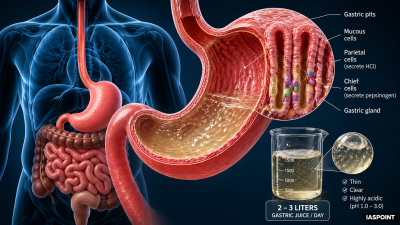
Gastric juice is a thin, clear, highly acidic digestive fluid secreted by the gastric glands located in the mucosal lining of the stomach. An average adult secretes approximately 2 to 3 liters of gastric juice daily. It is essential for the chemical breakdown of proteins and the sterilization of ingested food.
Composition of Gastric Juice
Gastric juice is a mixture of water, electrolytes, hydrochloric acid, and several enzymes. Its highly acidic nature (pH ranging from 1.5 to 2.5) is its most defining characteristic for UPSC Prelims.
| Component | Secreted By | Primary Function |
| Hydrochloric Acid (HCl) | Parietal (Oxyntic) Cells | Activates pepsin; kills pathogens; provides acidic medium. |
| Pepsinogen | Chief (Peptic) Cells | Inactive precursor; converted to Pepsin for protein digestion. |
| Prorennin | Chief (Peptic) Cells | Found in infants; helps in milk protein (casein) digestion. |
| Gastric Lipase | Chief (Peptic) Cells | Minor role in the breakdown of tributyrin (fats). |
| Mucus | Mucous Neck Cells | Lubricates stomach walls; prevents self-digestion by HCl. |
| Intrinsic Factor | Parietal (Oxyntic) Cells | Essential for the absorption of Vitamin B12 in the ileum. |
Mechanism of Enzymatic Action
The enzymes in gastric juice are typically secreted in an inactive “proenzyme” form to prevent the digestion of the gland’s own cellular proteins.
1. Protein Digestion
The inactive pepsinogen is activated by HCl into the active proteolytic enzyme, Pepsin.
- Reaction: Pepsinogen HCl→ Pepsin
- Action: Proteins Pepsin→ Proteoses + Peptones (smaller peptides).
2. Milk Digestion (Infants)
In infants, the gastric juice contains Prorennin.
- Reaction: Prorennin HCl→ Rennin
- Action: Casein (Milk Protein) Rennin→ Paracasein (Curdling of milk).
Regulation of Secretion
Gastric juice secretion occurs in three distinct phases:
- Cephalic Phase: Stimulated by the sight, smell, or thought of food; mediated by the Vagus nerve.
- Gastric Phase: Stimulated by the distension of the stomach and the presence of food (peptides); mediated by the hormone Gastrin.
- Intestinal Phase: Occurs when chyme enters the duodenum; involves hormones like Secretin and Cholecystokinin (CCK) which eventually inhibit gastric secretion to prevent over-acidification.
Clinical and Biological Trivia
- Achlorhydria: A condition where the stomach fails to produce HCl, often leading to poor protein digestion and Pernicious Anemia (due to lack of Intrinsic Factor).
- Auto-digestion Protection: The stomach avoids digesting itself because of a thick bicarbonate-rich mucus barrier and the fact that proteolytic enzymes are stored as inactive precursors.
- Vitamin B12 Link: UPSC often tests the link between the stomach and blood formation. Without the Parietal cells’ Intrinsic Factor, B12 cannot be absorbed, leading to a failure in Red Blood Cell (RBC) maturation.
- Bicarbonate Buffer: While the juice is acidic, the mucosal surface has a pH of nearly 7.0 due to bicarbonate ions, creating a steep pH gradient that protects the tissue.