

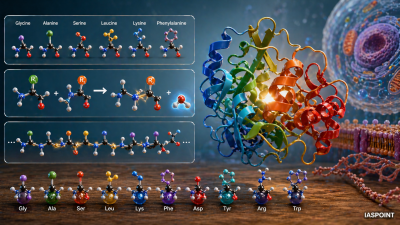
Proteins are large, complex biomacromolecules that serve as the primary structural and functional components of all living cells. Chemically, they are heteropolymers of amino acids. Unlike carbohydrates, which can be homopolymers (like starch), proteins are always composed of different types of amino acids linked in a specific sequence.
Amino Acids: The Monomeric Units
Amino acids are organic compounds containing an amino group (-NH2) and an acidic carboxyl group (-COOH) on the same carbon atom (the α-carbon).
- Chemical Structure: Every amino acid has a central carbon atom bonded to a hydrogen atom, an amino group, a carboxyl group, and a variable R-group (side chain) that determines the identity of the amino acid.
- Essential vs. Non-essential:
- Essential Amino Acids: Cannot be synthesized by the human body and must be obtained through diet (e.g., Valine, Leucine, Phenylalanine).
- Non-essential Amino Acids: Can be synthesized by the body from other precursors (e.g., Alanine, Glycine, Serine).
- Zwitterion Property: In aqueous solutions, amino acids can act as both acids and bases because the amino and carboxyl groups can ionize, carrying both a positive and negative charge.
Levels of Protein Structure
The function of a protein is strictly dependent on its three-dimensional shape. Biologists describe protein structure at four levels:
- Primary Structure: The linear sequence of amino acids in a polypeptide chain. This sequence is determined by genetic information and dictates how the protein will fold.
- Secondary Structure: Local folding of the polypeptide chain into specific shapes like the α-helix or β-pleated sheet, stabilized by hydrogen bonds.
- Tertiary Structure: The overall three-dimensional folding of a single polypeptide chain. This structure is stabilized by various bonds (disulfide bridges, ionic bonds, hydrophobic interactions) and is essential for the biological activity of proteins like enzymes.
- Quaternary Structure: The spatial arrangement of multiple polypeptide subunits. For example, Hemoglobin consists of four subunits (2α and 2β).
Classification by Function and Composition
Proteins are diverse and are categorized based on their roles within the organism.
| Category | Function | Examples |
| Enzymes | Biological catalysts that speed up reactions. | Pepsin, Trypsin, RuBisCO. |
| Structural | Provide support and framework. | Collagen (connective tissue), Keratin (hair/nails). |
| Transport | Carry substances across membranes or through blood. | Hemoglobin (Oxygen), GLUT-4 (Glucose). |
| Hormonal | Regulate physiological processes. | Insulin, Glucagon. |
| Protective | Defense against pathogens. | Antibodies (Immunoglobulins). |
| Contractile | Responsible for movement. | Actin, Myosin (Muscles). |
Critical Proteins in the Biosphere
- Collagen: It is the most abundant protein in the animal world, forming the major component of connective tissues like cartilage, tendons, and bones.
- RuBisCO: (Ribulose bisphosphate Carboxylase-Oxygenase) It is the most abundant protein in the whole biosphere. It is the key enzyme involved in carbon fixation during photosynthesis.
Denaturation of Proteins
Denaturation is the process where a protein loses its native shape (secondary, tertiary, or quaternary structure) due to external stress, such as:
- Temperature: High heat breaks hydrogen bonds and hydrophobic interactions.
- pH Changes: Alterations in acidity or alkalinity disrupt ionic bonds.
- Note: Denaturation does not break the peptide bonds of the primary structure, but it usually renders the protein biologically inactive (e.g., an egg white turning solid when cooked).
Fact File for UPSC Prelims
- Peptide Bond: The covalent bond that links amino acids, formed between the carboxyl group of one and the amino group of another with the loss of a water molecule.
- Glutelins: Storage proteins found in cereals (e.g., Gluten in wheat).
- Myoglobin: A protein that stores oxygen in muscle cells, similar to how hemoglobin transports it in the blood.
- Sickle Cell Anemia: A genetic disorder where a single amino acid substitution (Glutamic acid to Valine) in the hemoglobin chain changes the protein’s shape and function.
- Biuret Test: A chemical test used to detect the presence of peptide bonds (proteins). A positive result is indicated by a color change to violet or purple.