

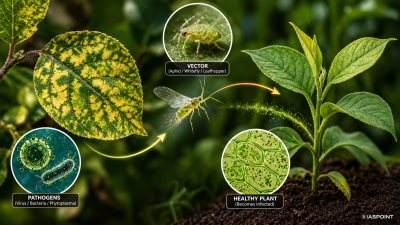
In plant pathology, a vector is an organism that transmits an infectious pathogen from an infected host to a healthy one. While fungi are often wind-borne, viruses and certain bacteria rely almost exclusively on biological vectors for dispersal.
Classification of Biological Vectors
The majority of plant disease vectors belong to the Phylum Arthropoda, specifically the Class Insecta. These vectors possess specialized mouthparts (piercing-sucking) that allow them to bypass the rigid plant cell wall.
Hemipteran Insects (Sucking Insects)
- Aphids (Plant Lice): The most common vectors for plant viruses. They transmit over 50% of known insect-vectored viruses, including the Potato Virus Y and Cucumber Mosaic Virus.
- Whiteflies: Specifically Bemisia tabaci, which is the primary vector for Yellow Vein Mosaic Virus (YVMV) in Bhindi (Okra) and Cotton Leaf Curl Virus.
- Leafhoppers and Planthoppers: These are primary vectors for phytoplasmas (wall-less bacteria) and viruses. The Rice Tungro Virus is transmitted by the Green Leafhopper (Nephotettix virescens).
Thrips and Beetles
- Thrips: Tiny insects that transmit Tospoviruses, such as the Tomato Spotted Wilt Virus (TSWV). They are unique because the virus must be acquired during the larval stage to be transmitted by the adult.
- Beetles: Unlike sucking insects, beetles transmit pathogens via contaminated mouthparts after chewing on infected tissues. They are known vectors for Bean Pod Mottle Virus.
Non-Insect Vectors
Pathogens can also be transmitted by organisms residing in the soil or through micro-organisms.
- Nematodes (Roundworms): Soil-dwelling nematodes of the genera Xiphinema and Longidorus transmit Nepoviruses (Nematode-transmitted polyhedral viruses), such as Grapevine Fanleaf Virus.
- Fungi and Protists: Some primitive fungi-like organisms, such as Olpidium brassicae, act as vectors for “soil-borne” viruses like the Lettuce Big Vein Virus.
- Mites: Arachnids like the Eriophyid mite are responsible for transmitting the Pigeon Pea Sterility Mosaic Disease, a significant threat to pulse production in India.
Mechanisms of Transmission
Vectors do not merely “carry” the disease; the relationship between the vector and the pathogen is often highly specific.
- Non-Persistent (Stylet-borne): The pathogen is carried on the mouthparts and is lost quickly (minutes to hours).
- Persistent (Circulative): The pathogen enters the vector’s body, circulates through the hemolymph, and reaches the salivary glands before it can be transmitted. This requires a “latent period.”
- Propagative: The pathogen actually multiplies within the body of the vector (e.g., certain leafhopper-transmitted viruses).
Table: Major Plant Diseases and Their Respective Vectors
| Disease | Causative Agent | Primary Vector |
| Yellow Vein Mosaic of Bhindi | Virus | Whitefly (Bemisia tabaci) |
| Rice Tungro Disease | Virus | Green Leafhopper |
| Potato Leaf Roll | Virus | Aphids (Myzus persicae) |
| Tomato Spotted Wilt | Virus | Thrips |
| Citrus Tristeza | Virus | Brown Citrus Aphid |
| Bunchy Top of Banana | Virus | Banana Aphid (Pentalonia nigronervosa) |
| Grassy Shoot of Sugarcane | Phytoplasma | Aphids / Leafhoppers |
UPSC Prelims Trivia: Fact-Check
- The “Flying Syringe”: Aphids are often called “flying syringes” because of their efficiency in injecting viral particles directly into the plant’s phloem.
- Citrus Canker Exception: Unlike many diseases mentioned above, Citrus Canker (caused by Xanthomonas axonopodis) is primarily spread by wind and rain splashes, though the Citrus Leaf Miner (an insect) creates wounds that facilitate the entry of the bacteria.
- Vector Specificity: Most viruses cannot be transmitted by just any insect; they require a specific protein interaction between the virus coat and the vector’s gut or salivary glands.