

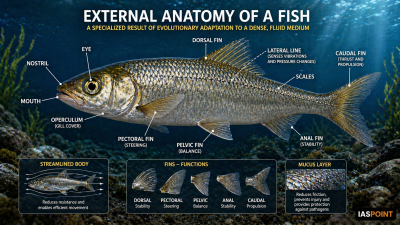
The external anatomy of a fish is a specialized result of evolutionary adaptation to a dense, fluid medium.
1. Body Segmentation and Shape
The body of a fish is typically divided into three distinct regions: Head, Trunk, and Tail.
- Streamlined Form: Most fishes possess a fusiform (spindle-shaped) body. This reduces “drag” or water resistance, allowing for energy-efficient swimming.
- Head Region: Extends from the snout to the posterior edge of the operculum (in bony fishes) or the last gill slit (in cartilaginous fishes). It houses the primary sensory organs including eyes (lacking eyelids), nostrils (olfactory sacs), and the mouth.
- Trunk Region: Extends from the end of the head to the vent or anus. It contains the majority of the muscular mass and the visceral organs.
- Tail Region: The portion posterior to the anus. It is the primary organ of locomotion.
2. Fin Systems (Appendages)
Fins are integumentary folds supported by either cartilaginous rods or bony rays. They are classified into two categories:
Paired Fins
These are homologous to the limbs of terrestrial vertebrates and are used for steering, balancing, and braking.
- Pectoral Fins: Located just behind the head on either side. They control directional movement and up-and-down pitching.
- Pelvic (Ventral) Fins: Located lower on the body, either abdominally or thoracically. They assist in stabilization.
Unpaired (Median) Fins
- Dorsal Fin: Located on the back. It prevents the fish from rolling and assists in sudden turns.
- Anal Fin: Located on the ventral side behind the anus; provides stability.
- Caudal Fin (Tail Fin): The main propeller.
- Heterocercal Tail: Asymmetrical (upper lobe larger), typical of Chondrichthyes (e.g., Sharks).
- Homocercal Tail: Symmetrical, typical of Osteichthyes (e.g., Rohu).
3. The Integumentary System: Scales
The skin of a fish is covered by scales, which provide protection and reduce turbulence. The type of scale is a primary taxonomic marker.
| Scale Type | Description | Occurrence |
| Placoid | Microscopic, tooth-like; contains enamel and dentine. | Sharks and Rays (Cartilaginous) |
| Cycloid | Smooth-edged, circular, and flexible. | Salmon, Carp (Bony Fish) |
| Ctenoid | Toothed or comb-like posterior edges; rough to touch. | Perch, Sunfish (Advanced Bony Fish) |
| Ganoid | Diamond-shaped, heavy, and bone-like. | Primitive bony fishes like Gar |
4. Specialized External Features
The Lateral Line System
Visible as a faint longitudinal line along the sides of the fish. It consists of a series of mechanoreceptors called neuromasts.
- Function: It allows the fish to detect “distant touch,” sensing low-frequency vibrations, water currents, and pressure changes. It is vital for schooling behavior and navigating in the dark.
Operculum and Gill Slits
- Operculum: A bony flap found in Osteichthyes that covers and protects the gills. It also acts as a pump to move water over the respiratory surfaces.
- Gill Slits: In Chondrichthyes, the operculum is absent, and 5–7 pairs of gill slits open directly to the exterior.
Mouth and Snout Variations
- Ventral Mouth: Located on the underside (common in Sharks).
- Terminal Mouth: Located at the tip of the snout (common in Bony Fish).
- Superior Mouth: Upward-pointing, typical of surface feeders.
Trivia for Prelims
- Barbels: Some fishes (like Catfish) have whisker-like sensory organs called barbels near the mouth, used to “taste” and feel the environment in murky water.
- Bioluminescence: Certain deep-sea fishes possess photophores (light-emitting organs) on their external surface to attract prey or mates.
- Mucus Layer: The “slime” on a fish’s exterior is a protective mucus that reduces friction and acts as a primary chemical barrier against parasites and bacteria.