

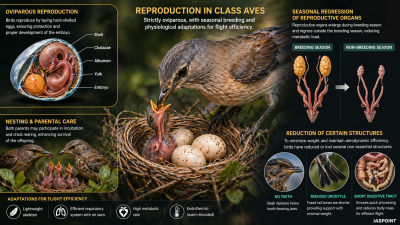
Reproduction in Class Aves is strictly oviparous. To maintain flight efficiency, birds have evolved unique physiological shortcuts, such as the seasonal regression of reproductive organs and the reduction of certain anatomical structures.
Anatomical Adaptations for Reproduction
- Asymmetry in Females: In most bird species, only the left ovary and left oviduct are functional. The right side remains vestigial to reduce unnecessary weight during flight.
- Seasonal Gonadal Growth: During the non-breeding season, the gonads (testes and ovaries) shrink significantly. They can increase in size by hundreds of times just before the breeding season in response to hormonal changes triggered by day length (Photoperiodism).
- Cloacal Kiss: Most birds lack external copulatory organs. Sperm transfer occurs through brief contact of the cloacal openings of the male and female, known as the “cloacal kiss.” (Notable exceptions include ducks and ostriches).
The Avian Egg: Structure and Function
Birds lay cleidoic eggs, which are self-contained life-support systems protected by a calcareous shell.
| Component | Description and Function |
| Shell | Made of Calcium Carbonate (CaCO3); porous to allow gas exchange while preventing excessive water loss. |
| Albumin | The “egg white”; provides protein and water to the developing embryo and acts as a shock absorber. |
| Yolk | High-fat energy source that nourishes the embryo throughout its development. |
| Chalaza | Spiral strands of tissue that suspend the yolk in the center of the egg, protecting it from mechanical shock. |
| Air Cell | Formed at the blunt end of the egg; provides the first breath of air for the chick just before hatching. |
Extra-Embryonic Membranes
Birds, along with reptiles and mammals, are Amniotes. They possess four specialized membranes that support the embryo within the egg:
- Amnion: A fluid-filled sac that cushions the embryo against mechanical shock.
- Chorion: The outermost membrane that facilitates gas exchange between the embryo and the external environment.
- Allantois: Acts as a disposal sac for nitrogenous wastes (uric acid) and assists in respiration.
- Yolk Sac: Encloses the yolk and transports nutrients to the embryo via a system of blood vessels.
Patterns of Development and Hatching
Development is direct, meaning there is no larval stage. The duration of incubation varies by species (e.g., 21 days for chickens).
Classification of Hatchlings
Based on their state of development at hatching, birds are divided into two categories:
- Altricial Birds: Chicks are hatched blind, naked (featherless), and helpless. They require intensive parental care and feeding (e.g., Sparrows, Crows, Pigeons).
- Precocial Birds: Chicks are hatched with open eyes, a coat of down feathers, and the ability to walk and feed themselves almost immediately (e.g., Ducks, Chickens, Megapodes).
Specialized Reproductive Behaviors
- Nidicolous vs. Nidifugous: Nidicolous birds stay in the nest for a long time (Altricial), while Nidifugous birds leave the nest shortly after hatching (Precocial).
- Brood Parasitism: A reproductive strategy where a bird (e.g., the Cuckoo or Koel) lays its eggs in the nest of another species (the host). The host bird unknowingly incubates and raises the parasite’s offspring, often at the expense of its own chicks.
- Incubation: The process of keeping eggs warm using body heat. Most birds develop a brood patch—a featherless area of skin on the abdomen heavily supplied with blood vessels to transfer heat to the eggs.
UPSC Prelims Trivia
- Egg Tooth: A small, sharp cranial projection on a hatchling’s beak used to pierce the shell during “pipping” (hatching). It falls off shortly after birth.
- Malleefowl (Megapodes): Unique birds that do not sit on their eggs; instead, they bury them in mounds of decomposing organic matter or volcanic ash, using the heat of fermentation or geothermal energy for incubation.
- Greatest Egg-to-Body Ratio: The Kiwi lays an egg that can weigh up to 25% of the mother’s body weight—the largest in proportion to body size of any bird.