

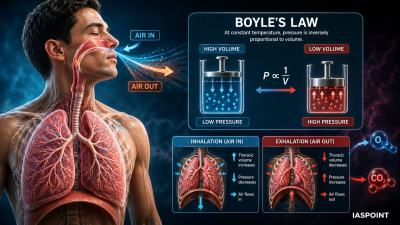
Breathing, or pulmonary ventilation, is the physical movement of air into and out of the lungs. This process is driven by pressure gradients created between the atmosphere and the thoracic cavity. It follows Boyle’s Law, which dictates that at a constant temperature, the pressure of a gas is inversely proportional to its volume.
The Mechanism of Inspiration
Inspiration is the phase during which atmospheric air is drawn into the lungs. It is an active process involving the contraction of skeletal muscles.
Muscular Action
- Diaphragm Contraction: The diaphragm moves downward (flattens), increasing the volume of the thoracic cavity in the antero-posterior axis.
- External Intercostal Contraction: These muscles lift the ribs and the sternum upward and outward, increasing the thoracic volume in the dorso-ventral axis.
Pressure Changes
- The overall increase in thoracic volume causes a proportional increase in pulmonary volume.
- According to Boyle’s Law, this expansion causes the intra-pulmonary pressure to fall below the atmospheric pressure (creating a negative pressure).
- Air rushes from the outside (high pressure) into the lungs (low pressure) until the pressures are equalized.
The Mechanism of Expiration
Expiration is the phase where alveolar air is released into the atmosphere. Under normal resting conditions, it is a passive process.
Muscular Action
- Diaphragm Relaxation: The diaphragm relaxes and returns to its original dome-like shape.
- External Intercostal Relaxation: The ribs and sternum return to their original positions due to the elastic recoil of the thoracic wall and lungs.
Pressure Changes
- The relaxation of these muscles reduces the thoracic and pulmonary volume.
- This volume reduction increases the intra-pulmonary pressure to a level slightly higher than the atmospheric pressure.
- The pressure gradient forces air out of the lungs into the atmosphere.
Comparative Analysis: Inspiration vs. Expiration
| Feature | Inspiration | Expiration (Normal) |
| Nature of Process | Active (Energy used) | Passive (Elastic recoil) |
| Diaphragm | Contracts and flattens | Relaxes and becomes dome-shaped |
| External Intercostals | Contract (Ribs move up/out) | Relax (Ribs move down/in) |
| Thoracic Volume | Increases | Decreases |
| Intra-pulmonary Pressure | Decreases (Lower than atmosphere) | Increases (Higher than atmosphere) |
| Direction of Airflow | Into the lungs | Out of the lungs |
Forced Breathing (Active Expiration)
During physical exertion, coughing, or sneezing, expiration becomes an active process.
- Abdominal Muscles: Contraction of abdominal muscles pushes the viscera against the diaphragm, forcing it further upward.
- Internal Intercostal Muscles: These muscles contract to pull the rib cage further downward and inward, rapidly decreasing thoracic volume.
Key Respiratory Parameters for UPSC
- Respiratory Rate: A healthy human breathes 12–16 times per minute on average.
- Spirometer: A clinical instrument used to measure the volume of air involved in breathing movements, aiding in the assessment of pulmonary functions.
- Anatomical Dead Space: The volume of air (approx. 150 mL) that remains in the conducting respiratory passages (trachea, bronchi) and does not participate in gas exchange.
- Surface Tension: The presence of Lecithin (a phospholipid surfactant) prevents the alveoli from collapsing during expiration by reducing surface tension.