

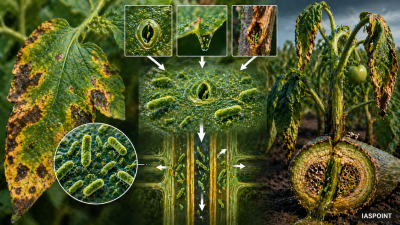
Bacterial diseases in plants are generally less frequent than fungal or viral infections but are significantly more destructive due to their rapid multiplication and systemic nature. These pathogens typically enter plants through natural openings (stomata, hydathodes) or wounds caused by insects, pruning, or weather damage.
Mechanisms of Infection
Bacteria damage plants through various physiological disruptions:
- Vascular Wilting: Bacteria multiply in the xylem, physically blocking the transport of water and minerals.
- Necrosis: Release of enzymes that degrade cell walls, leading to tissue death (spots, blights).
- Soft Rots: Secretion of pectinolytic enzymes that dissolve the “middle lamella,” turning plant tissue into a pulpy mass.
- Hypertrophy: Induction of abnormal cell division leading to galls or tumors.
Major Bacterial Diseases in Plants
| Disease Name | Causal Organism | Primary Host | Key Symptoms |
| Bacterial Leaf Blight | Xanthomonas oryzae | Rice (Paddy) | Yellowing of leaves from tip downwards; “milky” bacterial ooze. |
| Citrus Canker | Xanthomonas citri | Lemon, Orange, Lime | Brown, eruptive, scabby lesions on leaves, stems, and fruits. |
| Crown Gall | Agrobacterium tumefaciens | Dicots (Roses, Fruit trees) | Large tumor-like swellings at the junction of root and stem. |
| Black Rot | Xanthomonas campestris | Crucifers (Cabbage, Cauliflower) | V-shaped yellow lesions on leaf margins; blackening of veins. |
| Fire Blight | Erwinia amylovora | Apples, Pears | Blossoms and leaves appear “burnt” or scorched. |
| Soft Rot | Erwinia carotovora | Potato, Carrot, Onion | Tissues become soft, watery, and foul-smelling. |
| Wildfire of Tobacco | Pseudomonas syringae | Tobacco | Leaves develop chlorotic halos around necrotic centers. |
Special Pathogen: Agrobacterium tumefaciens
In UPSC Science and Technology, Agrobacterium tumefaciens is frequently mentioned due to its role in Genetic Engineering.
- The “Natural Genetic Engineer”: This bacterium possesses a Ti-plasmid (Tumor-inducing plasmid).
- Mechanism: It transfers a segment of its DNA (T-DNA) into the host plant’s genome to force the plant to produce nutrients for the bacteria.
- Biotechnology Application: Scientists use modified Ti-plasmids as vectors to insert desired genes into plants to create Genetically Modified (GM) crops.
Transmission Vectors
Unlike human bacterial diseases, plant bacteria rely heavily on external agents for dispersal:
- Water: Rain splash and irrigation water.
- Insects: Leafhoppers and beetles act as mechanical carriers.
- Human Activity: Contaminated tools, infected seeds, and movement of nursery stock.
- Wind: Often carries bacterial cells over short distances during storms.
Control and Management Strategies
- Antibiotics: Streptomycin and Tetracycline are occasionally used in high-value horticulture.
- Bactericides: Copper-based fungicides (like Bordeaux mixture) also act as effective bactericides.
- Biological Control: Using antagonistic bacteria like Pseudomonas fluorescens to suppress soil-borne pathogens.
- Quarantine: Preventing the movement of infected plant material across borders (e.g., checking for Citrus Canker in imports).
Fact-Sheet for UPSC Prelims
- Ring Disease of Potato: Caused by Pseudomonas solanacearum, it creates a characteristic brown ring in the tuber’s vascular bundle.
- Tundu Disease of Wheat: A complex disease caused by the association of the bacterium Clavibacter tritici and the nematode Anguina tritici.
- Smallest Pathogens: While most plant diseases are bacterial, Phytoplasmas (specialized bacteria without cell walls, similar to Mycoplasma) cause “Little Leaf” diseases and are transmitted by insects.
- Xanthomonas: This genus is responsible for a vast majority of the “Blight” and “Canker” diseases identified in Indian agriculture.