

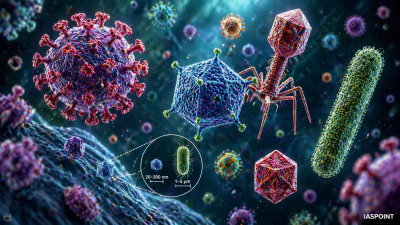
Viruses are non-cellular organisms characterized by having an inert crystalline structure outside the living cell. They are significantly smaller than bacteria, typically ranging from 20 to 300 nanometers.
The Genetic Core
- Nucleic Acid: A virus contains only one type of nucleic acid, either DNA or RNA.
- Configuration: The genetic material can be linear or circular, and exists as either Single-Stranded (ss) or Double-Stranded (ds).
- Infectivity: In most plant viruses, the genetic material is ssRNA, whereas animal viruses can have ssRNA, dsRNA, or dsDNA. Bacteriophages are usually dsDNA viruses.
The Capsid (Protein Coat)
- Definition: The nucleic acid is protected by a protein shell called the Capsid.
- Capsomeres: The capsid is made of small subunits called capsomeres, which are arranged in helical or polyhedral geometric forms.
- Function: It protects the viral genome from nucleases and aids in the attachment to host cell receptors.
The Envelope (Optional)
- Enveloped Viruses: Some viruses have an outer thin loose covering composed of proteins, lipids, and carbohydrates (e.g., HIV, Influenza, SARS-CoV-2).
- Non-enveloped (Naked) Viruses: Viruses consisting only of a nucleocapsid (e.g., Poliovirus).
Morphological Types of Viruses
Viruses are classified based on the geometric symmetry of their capsid.
Helical Symmetry
The capsomeres are arranged in a hollow coil or rod shape. The nucleic acid is wound spirally inside.
- Example: Tobacco Mosaic Virus (TMV).
Icosahedral (Polyhedral) Symmetry
The capsid is a regular polyhedron with 20 equilateral triangular faces and 12 corners.
- Example: Adenovirus (causes respiratory infections), Poliovirus.
Complex Symmetry
These viruses possess a combination of structures. A classic example is the Bacteriophage, which has a polyhedral head and a helical tail.
- Structure: Head (contains DNA), Collar, Sheath, Tail pins, and Base plate with Tail fibers.
Classification based on Nucleic Acid Type
| Class | Type of Nucleic Acid | Examples |
| ssDNA | Single-stranded DNA | Phage φ × 174 |
| dsDNA | Double-stranded DNA | T-4 Bacteriophage, Variola virus (Smallpox), Adenovirus |
| ssRNA | Single-stranded RNA | TMV, HIV (Retrovirus), Influenza, SARS-CoV-2, Ebola |
| dsRNA | Double-stranded RNA | Reoviruses (causes gastroenteritis) |
Important Viral Variants and Related Entities
Retroviruses
These are a specific group of RNA viruses that utilize the enzyme Reverse Transcriptase. This enzyme allows them to transcribe their RNA genome into DNA, which is then integrated into the host’s genome.
- Trivia: HIV is the most well-known human retrovirus.
Viroids
Discovered by T.O. Diener in 1971, these are infectious agents smaller than viruses.
- Composition: They consist of a low molecular weight free RNA without a protein coat.
- Disease: Potato Spindle Tuber disease.
Prions
These are infectious particles composed entirely of abnormally folded proteins. They do not contain any nucleic acid.
- Diseases: Bovine Spongiform Encephalopathy (BSE/Mad Cow Disease) in cattle and Cr-Jacob disease (CJD) in humans.
Summary List of Viral Shapes and Examples
- Rod-shaped: Tobacco Mosaic Virus (TMV).
- Spherical: Influenza virus, HIV.
- Tadpole-shaped: Bacteriophages.
- Bullet-shaped: Rabies virus.
- Brick-shaped: Poxvirus (Smallpox).
Fact Check for UPSC Prelims
- Living or Non-living? Viruses are inert outside the host cell (non-living) but replicate using host machinery (living). They lack their own metabolic machinery like ribosomes.
- Antibiotics: Antibiotics do not work against viruses because viruses do not have bacterial cell walls or metabolic pathways that antibiotics typically target.
- First Discovery: D.J. Ivanowsky (1892) recognized certain microbes as the cause of mosaic disease of tobacco; M.W. Beijerinek (1898) demonstrated the infectious nature and called the fluid Contagium vivum fluidum (infectious living fluid).