

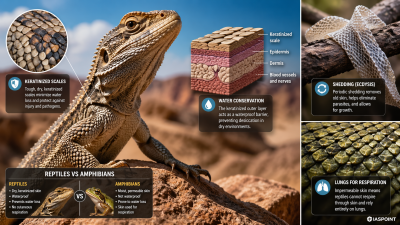
The reptilian skin is a sophisticated evolutionary adaptation that allowed vertebrates to colonize dry land. Unlike the moist, permeable skin of amphibians, reptilian skin is heavily keratinized, providing a biological seal against the external environment.
Structural Composition of the Skin
Reptilian skin consists of two primary layers: the Epidermis (outer) and the Dermis (inner).
- Epidermis: This layer is devoid of glands (except for specialized scent glands) and produces the protein Keratin. It creates the scales and prevents water loss through evaporation.
- Dermis: The thicker, vascularized inner layer containing connective tissue, blood vessels, and nerves. In certain groups, it contains bony plates.
- Chromatophores: Located in the dermis, these specialized pigment cells allow for color changes, which are used for thermoregulation, camouflage, and communication (e.g., in Chameleons).
Types of Scales and Surface Structures
Scales are not separate attachments but are continuous folds of the epidermal layer.
- Granular Scales: Small, pebble-like scales found in many lizards, providing flexibility.
- Overlapping Scales: Seen in most snakes and lizards (Squamata), where the posterior edge of one scale covers the anterior edge of the next, providing a “shingle” effect for better protection and movement.
- Scutes: Large, shield-like scales found on the underbelly of snakes (ventral scales) for traction, and on the shells of turtles.
- Tubercles: Raised, often pointed scales that provide a rough texture, common in Geckos.
Specialized Integumentary Features
Osteoderms (Dermal Armor)
In Crocodilians and some lizards (like the Skink), the dermis contains bony plates called osteoderms. These act as a secondary internal armor beneath the keratinized scales, providing significant protection against predators.
The Turtle Shell
The shell of a turtle is a unique modification where the skin, ribs, and vertebrae are fused.
- Carapace: The dorsal (upper) part of the shell.
- Plastron: The ventral (lower) part.
- Both are covered by keratinous scutes, though “soft-shelled” turtles have a leathery skin covering instead.
Digital Lamellae
Found on the underside of the toes of Geckos and some Anoles, these are modified scales containing millions of microscopic hair-like structures (setae). These allow the reptiles to adhere to smooth surfaces through molecular-level attraction.
Ecdysis: The Process of Molting
Since the keratinized skin is relatively inelastic, reptiles must shed it to accommodate growth.
- Mechanism: A new layer of epidermis grows beneath the old one. A fluid (molting fluid) is secreted between the layers to help them separate.
- Snakes: Usually shed their skin in a single, continuous piece. The Brille (spectacle), a transparent scale over the eye, is also shed, which is why a snake’s eyes look “cloudy” or “blue” just before molting.
- Lizards and Crocodilians: Generally shed their skin in patches or flakes.
Biological Functions of Reptilian Skin
| Function | Description |
| Water Conservation | The primary role is to prevent Desiccation (dehydration) in arid environments. |
| Protection | Provides a physical barrier against mechanical injury and ultraviolet (UV) radiation. |
| Locomotion | Ventral scutes in snakes provide the necessary friction for “slithering” or rectilinear movement. |
| Sensation | Contains mechanoreceptors that detect vibrations and pressure. |
| Thermoregulation | Darker skin colors absorb more solar radiation to help the cold-blooded animal warm up. |
Comparative Trivia for UPSC
- Permeability: Amphibian skin is highly permeable to water and gases; Reptilian skin is virtually impermeable.
- Glands: Reptiles are “dry-skinned” because they lack sweat or sebaceous glands. However, they may have Femoral glands (in lizards) or Scent glands (near the cloaca in snakes) for chemical signaling.
- Chemical Defense: Some reptiles, like the Rhabdophis snakes, can sequester toxins from their prey and store them in specialized nuchal glands in their skin.