

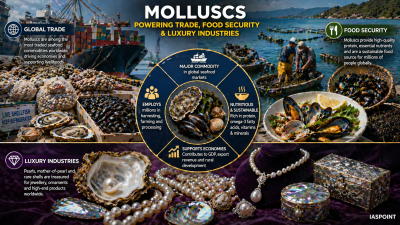
Molluscs play a vital role in global trade, food security, and luxury industries.
1. Edible Resources (Fisheries and Aquaculture)
Molluscs serve as a primary source of high-protein, low-fat food for human populations worldwide.
- Bivalves: Clams, mussels, and scallops are extensively farmed (mariculture).
- Cephalopods: Squids (Loligo), Cuttlefish (Sepia), and Octopuses are major export commodities for India, particularly from the Malabar and Coromandel coasts.
- Gastropods: Land snails (like Helix) are considered delicacies in European and East Asian cuisines.
2. Pearl Industry (Pearl Culture)
The production of natural and cultured pearls is one of the most lucrative sectors of malacology.
- Primary Source: The Pearl Oyster, specifically the genus Pinctada (e.g., Pinctada vulgaris).
- Formation: Pearls are formed when a foreign particle (irritant) gets trapped between the mantle and the shell; the mantle secretes concentric layers of Nacre (Mother of Pearl), composed of calcium carbonate and conchiolin.
3. Ornamental and Industrial Uses
- Shell Industry: The shells of molluscs like Cypraea (Cowries) and Turbinella pyrum (Sacred Chank) are used for making jewelry, buttons, and traditional artifacts.
- Lime Production: Large quantities of mollusc shells are processed to produce high-quality lime (calcium oxide), used in construction, paper manufacturing, and agriculture to neutralize acidic soil.
- Byssus Threads: Certain bivalves (like Pinna) produce strong silk-like fibers used historically to weave “sea silk.”
Ecological Importance of Molluscs
Ecologically, molluscs are indispensable components of aquatic food webs and serve as indicators of environmental health.
1. Bio-indicators of Pollution
Molluscs are “sentinel species.” Because they are sessile (stationary) or slow-moving and filter large volumes of water, they accumulate heavy metals (mercury, lead) and toxins in their tissues. Monitoring their health helps scientists assess the pollution levels of water bodies.
2. Natural Water Filters
Bivalves (oysters and mussels) act as natural bio-filters. A single oyster can filter up to 190 liters of water per day, removing excess nutrients, algae, and suspended silt, which prevents eutrophication and improves water clarity for aquatic plants.
3. Trophic Links in Food Webs
Molluscs bridge the gap between primary producers (plankton) and higher trophic levels.
- They consume phytoplankton and detritus.
- They serve as the primary prey for various fish, sea birds, and marine mammals (like sperm whales which feed almost exclusively on giant squids).
4. Ecosystem Engineers
Certain molluscs create complex physical structures that provide habitats for other species.
- Oyster Reefs: These reefs provide protection against coastal erosion, serve as nurseries for juvenile fish, and increase biodiversity.
- Shell Remnants: Empty shells provide shelter for hermit crabs, small fish, and various marine invertebrates.
Negative Economic and Ecological Impact
While largely beneficial, certain molluscs pose challenges to human activity and biodiversity.
| Feature | Impact Description |
| Shipworms (Teredo) | Known as the “termites of the sea,” these wood-boring bivalves damage wooden ships, docks, and submerged timber structures. |
| Agricultural Pests | Slugs and land snails (e.g., African Giant Snail) cause significant damage to horticultural crops and gardens. |
| Invasive Species | Species like the Zebra Mussel clog water intake pipes of power plants and outcompete native species, disrupting local ecosystems. |
| Disease Vectors | Certain freshwater snails act as intermediate hosts for trematode parasites, causing diseases like Schistosomiasis (Bilharzia) in humans and livestock. |
Trivia and Facts for UPSC Prelims
- Sepia Bone: The internal shell of cuttlefish is used as a calcium supplement for pet birds and in toothpaste for its abrasive quality.
- Tyrian Purple: Historically, a highly prized purple dye was extracted from the mucus of the sea snail Murex. It was known as “Royal Purple” due to its rarity and cost.
- Radula Power: Some predatory snails (like the Cone Snail) have a radula modified into a venom-injecting harpoon, capable of killing fish and, in some cases, humans.