

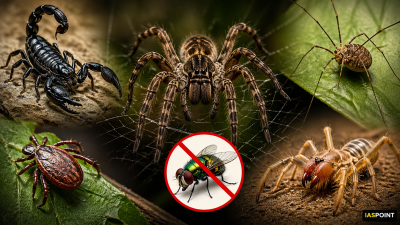
Arachnids belong to the Phylum Arthropoda and the Subphylum Chelicerata. Within this subphylum, they constitute the Class Arachnida. Unlike insects, which belong to the Subphylum Hexapoda, arachnids are characterized by a specific body plan and the absence of antennae.
Morphological Characteristics of Arachnida
The anatomy of arachnids is distinct from other arthropods, particularly insects, in several key biological aspects:
Body Segmentation
The arachnid body is divided into two primary tagmata rather than three:
- Cephalothorax (Prosoma): A fusion of the head and the thorax. This region bears the eyes, mouthparts, and all locomotive appendages.
- Abdomen (Opisthosoma): The posterior part of the body which houses the reproductive organs, digestive tract, and respiratory structures.
Appendages and Limbs
Arachnids possess six pairs of jointed appendages, all located on the cephalothorax:
- Chelicerae (1 pair): Modified mouthparts used for feeding or defense; in spiders, these are often connected to venom glands.
- Pedipalps (1 pair): Used for sensing, prey manipulation, or reproduction. In scorpions, these are modified into large pincers (chelae).
- Walking Legs (4 pairs): Totaling eight legs, which is a primary diagnostic feature distinguishing them from the six-legged insects.
Physiological Systems and Respiration
Arachnids have adapted to diverse environments, leading to specialized internal systems:
Respiratory Organs
Arachnids utilize three main types of respiratory structures depending on the order:
- Book Lungs: Unique leaf-like stacks of respiratory tissue (e.g., found in many spiders and scorpions).
- Tracheae: A system of tubes similar to those in insects.
- Diffusion: In very small arachnids like certain mites, respiration occurs directly through the thin cuticle.
Sensory and Circulatory Systems
- Eyes: Most possess simple eyes called ocelli rather than compound eyes. Spiders typically have eight ocelli.
- Excretion: Primary waste is excreted as uric acid or guanine through Malpighian tubules or coxal glands, an adaptation for water conservation in terrestrial habitats.
- Circulation: They possess an open circulatory system where hemolymph (blood) bathes the organs directly in a cavity called the hemocoel.
Major Orders within Class Arachnida
The following table summarizes the diversity within the class:
| Order | Common Name | Key Features |
| Araneae | Spiders | Produce silk via spinnerets; possess venomous chelicerae. |
| Scorpiones | Scorpions | Segmented tail with a terminal stinger; large pincer pedipalps. |
| Acari | Mites and Ticks | Cephalothorax and abdomen are fused; many are parasitic. |
| Opiliones | Harvestmen | “Daddy longlegs”; do not produce silk or venom; fused body. |
| Pseudoscorpiones | Pseudoscorpions | Small, tick-like with pincers but no stinging tail. |
| Solifugae | Camel Spiders | Large chelicerae; known for high speed and desert adaptation. |
Comparative Analysis: Arachnids vs. Insects
For UPSC Prelims, distinguishing between these two classes is crucial:
| Feature | Arachnids | Insects |
| Body Divisions | 2 (Cephalothorax, Abdomen) | 3 (Head, Thorax, Abdomen) |
| Number of Legs | 8 (4 pairs) | 6 (3 pairs) |
| Antennae | Absent | Present (1 pair) |
| Wings | Never present | Often present |
| Eyes | Simple ocelli | Compound eyes and ocelli |
| Mouthparts | Chelicerae | Mandibles |
Ecological and Economic Significance
- Biological Control: Spiders act as natural apex predators in the micro-ecosystem, controlling populations of agricultural pests and disease-carrying insects.
- Medical Importance: Ticks (Order Acari) are vectors for diseases such as Lyme disease and Kyasanur Forest Disease (KFD) in India.
- Venom Research: Arachnid toxins are being studied for applications in neurobiology and as potential non-addictive painkillers.
- Silk Production: Spider silk is one of the strongest natural fibers, currently researched for use in biodegradable polymers and medical sutures.
Important Facts for UPSC Prelims
- Not all Spiders spin webs: While all spiders produce silk, many use it for lining burrows or wrapping prey rather than catching it in a web (e.g., Wolf Spiders).
- Blue Blood: Some arachnids, like certain scorpions, use hemocyanin (copper-based) to transport oxygen, which gives their blood a bluish tint when oxygenated.
- External Digestion: Most arachnids cannot ingest solid food. They inject digestive enzymes into their prey to liquefy tissues before sucking the fluid.
- Evolutionary History: Arachnids were among the first animals to colonize land, with fossil evidence dating back to the Silurian period (approx. 420 million years ago).