

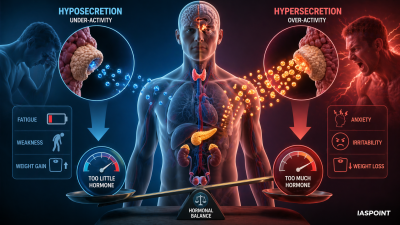
Hormonal disorders arise due to hyposecretion (under-activity) or hypersecretion (over-activity) of endocrine glands.
Thyroid Gland Disorders
The thyroid gland requires iodine to synthesize T3 and T4. Disorders are primarily categorized by functional status.
Hypothyroidism (Under-secretion)
- Simple Goitre: Caused by iodine deficiency in the diet. The thyroid gland enlarges in an attempt to trap more iodine. Common in hilly regions (endemic goitre).
- Cretinism: Occurs during pregnancy due to hypothyroidism. It leads to stunted growth, mental retardation, low Intelligence Quotient (IQ), and deaf-mutism in the child.
- Myxedema (Gull’s Disease): Hypothyroidism in adults, characterized by lethargy, weight gain, and puffiness of the face due to water retention.
Hyperthyroidism (Over-secretion)
- Exophthalmic Goitre (Graves’ Disease): An autoimmune disorder where antibodies mimic TSH.
- Symptoms: Enlargement of the thyroid, weight loss, increased Basal Metabolic Rate (BMR), and Exophthalmos (protrusion of the eyeballs).
Pancreatic Disorders: The Diabetes Spectrum
The pancreas regulates blood glucose through insulin and glucagon. Failure of this mechanism leads to “Diabetes.”
| Feature | Diabetes Mellitus | Diabetes Insipidus |
| Hormone Involved | Insulin Deficiency (or resistance) | ADH / Vasopressin Deficiency |
| Gland | Pancreas (Islets of Langerhans) | Hypothalamus / Posterior Pituitary |
| Primary Symptom | Hyperglycemia (High blood sugar) | Polyuria (Excessive dilute urine) |
| Urine Content | Contains Glucose (Glycosuria) | No Glucose (Insipid/Tasteless) |
| Complications | Ketone body formation, organ damage | Severe dehydration, extreme thirst |
Pituitary Gland Disorders
The Pituitary gland (Master Gland) regulates growth and other glands; imbalances lead to structural abnormalities.
- Gigantism: Hypersecretion of Growth Hormone (GH) during childhood/adolescence leading to abnormal height.
- Acromegaly: Hypersecretion of GH in adults. It does not increase height but causes severe disfigurement, especially of the face, hands, and feet. It is often hard to diagnose in early stages.
- Dwarfism: Hyposecretion of GH during childhood, resulting in stunted physical growth but usually normal mental development.
Adrenal Gland Disorders
The Adrenal Cortex produces life-sustaining steroid hormones (Cortisol and Aldosterone).
- Addison’s Disease: Hyposecretion of corticoid hormones.
- Symptoms: Acute fatigue, muscular weakness, skin pigmentation (bronzing), and low blood pressure.
- Cushing’s Syndrome: Hypersecretion of Cortisol (often due to a tumor).
- Symptoms: High blood pressure, “Moon Face,” and redistribution of body fat to the upper back (Buffalo Hump).
Calcium Metabolism Disorders
Regulation of Ca2+ is managed by the Parathyroid (PTH) and Thyroid (Calcitonin).
- Hypocalcemic Tetany: Caused by hyposecretion of PTH. Low blood calcium levels lead to muscle spasms and sustained contractions.
- Osteoporosis: Can be aggravated by hypersecretion of PTH, which causes excessive bone resorption (demineralization), making bones brittle and prone to fractures.
Summary Table of Key Hormonal Terms for Prelims
| Disorder | Affected Hormone | Key Clinical Marker |
| Hashimoto’s Disease | Thyroid Hormones | Autoimmune destruction of the thyroid gland. |
| Diabetes Mellitus Type 1 | Insulin | Total lack of insulin; usually juvenile onset. |
| Diabetes Mellitus Type 2 | Insulin | Insulin resistance; associated with obesity/lifestyle. |
| Conn’s Syndrome | Aldosterone | Excess Na^+ retention and high blood pressure. |
| Pheochromocytoma | Adrenaline | Tumor of adrenal medulla causing severe hypertension. |