

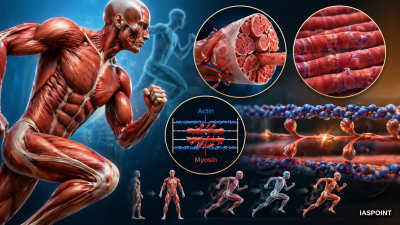
Muscle tissue is a specialized animal tissue characterized by its ability to contract and relax, thereby facilitating movement and locomotion. Derived primarily from the mesoderm (one of the three primary germ layers), it constitutes approximately 40% to 50% of the total body weight in a healthy adult. The cells of muscle tissue, known as myocytes, contain specialized proteins—actin and myosin—that interact to generate force.
Physiological Characteristics of Muscle Tissue
Muscle tissues exhibit four unique properties essential for physiological functions:
- Excitability: The capacity to receive and respond to stimuli from the nervous system or hormones.
- Contractility: The ability to shorten forcefully when adequately stimulated.
- Extensibility: The ability to be stretched or extended without damage.
- Elasticity: The capacity to recoil and resume original resting length after stretching.
Classification of Muscle Tissues
Based on their location, appearance, and nature of regulation, muscle tissues are categorized into three distinct types: Skeletal, Smooth, and Cardiac.
1. Skeletal Muscle (Striated or Voluntary Muscle)
These are primarily attached to the skeletal bones by tendons and are responsible for body posture and locomotion.
- Structure: Cells are long, cylindrical, unbranched, and multinucleated (syncytial). They exhibit alternate light and dark bands called striations.
- Regulation: Under the conscious control of the Somatic Nervous System (Voluntary).
- Function: Powerful, rapid contractions for short durations; however, they fatigue easily.
- Location: Biceps, triceps, leg muscles, and abdominal wall.
2. Smooth Muscle (Non-striated or Involuntary Muscle)
These muscles are located in the walls of hollow internal organs and do not exhibit any cross-striations.
- Structure: Cells are spindle-shaped (fusiform) with a single central nucleus. They are held together by cell junctions and bundled in connective tissue sheaths.
- Regulation: Controlled by the Autonomic Nervous System (Involuntary).
- Function: Slow and sustained contractions; they do not fatigue easily. They facilitate “housekeeping” functions like peristalsis.
- Location: Alimentary canal (esophagus to rectum), blood vessels, iris of the eye, and ureters.
3. Cardiac Muscle
A specialized tissue found exclusively in the heart, combining the features of both skeletal and smooth muscles.
- Structure: Cells are cylindrical, branched, and uninucleated. They possess striations and unique communication junctions called intercalated discs.
- Regulation: Involuntary; regulated by the heart’s internal pacemaker (SA node) and influenced by the Autonomic Nervous System.
- Function: Rhythmic contraction and relaxation throughout life without fatigue.
- Location: Myocardium (wall of the heart).
Comparative Analysis of Muscle Types
| Feature | Skeletal Muscle | Smooth Muscle | Cardiac Muscle |
| Shape | Cylindrical | Spindle-shaped | Cylindrical & Branched |
| Striations | Present | Absent | Present |
| Nucleus | Multinucleated (Peripheral) | Uninucleated (Central) | Uninucleated (Central) |
| Control | Voluntary | Involuntary | Involuntary |
| Fatigue | High/Fast | Very Low | Never fatigues |
| Connection | Attached to bones | In visceral organs | Heart walls only |
| Special Feature | Sarcoplasmic reticulum is abundant | Caveolae present | Intercalated discs |
Functional Significance of Muscle Tissues
- Movement: Facilitates both voluntary movements (walking, writing) and involuntary movements (heartbeat, breathing).
- Postural Stability: Skeletal muscles maintain body uprightness and stability against gravity.
- Thermogenesis: Muscle contractions produce heat as a byproduct, which is vital for maintaining homeostatic body temperature (e.g., shivering).
- Circulation: Cardiac muscles pump blood, while smooth muscles in vessels regulate blood pressure through vasoconstriction and vasodilation.
- Digestion: Smooth muscles in the gastrointestinal tract move food through the system via peristaltic waves.
Important Facts and Trivia for UPSC
- Sarcomere: The functional unit of contraction in a skeletal muscle fiber, defined as the region between two Z-lines.
- Myoglobin: A red pigment (oxygen-storing protein) found in muscles. Muscles rich in myoglobin are “Red Fibers” (aerobic), while those with less are “White Fibers” (anaerobic).
- Rigor Mortis: A state of muscle rigidity following death, caused by the depletion of ATP, which prevents the detachment of myosin heads from actin filaments.
- Lactic Acid: During strenuous exercise, skeletal muscles undergo anaerobic respiration, leading to the accumulation of lactic acid, which causes muscle fatigue and soreness.
- Hypertrophy vs. Atrophy: An increase in muscle mass due to exercise is hypertrophy; the wasting away of muscle due to disuse is atrophy.
- Sartorius: The longest muscle in the human body, running from the hip to the knee.
- Stapedius: The smallest muscle in the human body, located in the middle ear.