

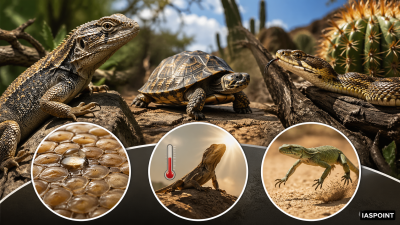
Reptiles are the first group of vertebrates to achieve complete independence from aquatic habitats. Their adaptations are centered around three core challenges: moisture retention, temperature regulation, and terrestrial locomotion.
Morphological Adaptations for Water Conservation
The transition to dry land required structural changes to prevent desiccation (drying out).
- Keratinized Skin: Reptilian skin is thick, dry, and non-glandular. The presence of Beta-keratin creates a waterproof barrier that minimizes water loss through the skin.
- Scales and Scutes: These provide mechanical protection against abrasion and predators. In desert species, scales are often keeled or pointed to reduce the surface area exposed to the sun.
- Uricotelism: To conserve internal water, reptiles excrete nitrogenous waste as Uric Acid rather than urea or ammonia. Uric acid is insoluble and requires minimal water for excretion, appearing as a semi-solid white paste.
Physiological Adaptations for Thermoregulation
As Ectotherms (Poikilotherms), reptiles do not generate internal heat and have evolved sophisticated behaviors to manage body temperature.
- Heliothermy: This is the practice of basking in the sun to absorb solar radiation. By Orienting their bodies perpendicular to the sun’s rays, reptiles maximize heat gain.
- Thermal Gaping: Crocodilians often sit with their mouths open to allow heat to escape through the mouth’s lining, cooling the brain.
- Color Change: Some lizards, like Chameleons, can darken their skin to absorb more heat in the morning and lighten it to reflect sunlight during the afternoon.
- Brumation: A physiological shutdown during winter where the metabolic rate drops to near zero, allowing survival when external temperatures are too low for activity.
Anatomical Adaptations for Predation and Defense
- Jacobson’s Organ (Vomeronasal Organ): Snakes and many lizards use a forked tongue to “sample” air particles. The tongue delivers these particles to this specialized organ in the roof of the mouth, providing a highly sensitive chemical map of the environment.
- Infrared Pit Organs: Found in Pit Vipers and Pythons, these heat-sensing organs detect the infrared radiation of warm-blooded prey, allowing the reptile to hunt in total darkness.
- Caudal Autotomy: Many lizards can voluntarily shed their tails when grabbed by a predator. The detached tail continues to wriggle, distracting the predator while the lizard escapes. The tail later regenerates.
- Thecodont Dentition: In Crocodilians, teeth are set in deep bony sockets, providing the structural strength required to grip and drown large prey.
Specialized Adaptations in Key Indian Species
| Species | Primary Adaptation | Biological Purpose |
| Gharial | Long, Narrow Snout | Reduces water resistance for rapid side-to-side fish hunting. |
| Sea Turtles | Salt Glands | Excretes excess salt from seawater through “tears” near the eyes. |
| Flying Lizard (Draco) | Patagia (Wing-like membranes) | Extensions of the ribs covered in skin that allow gliding between trees. |
| Gecko | Van der Waals Forces | Microscopic hairs (setae) on toe pads allow walking on vertical glass. |
| King Cobra | Ophiophagy | Anatomical and chemical resistance to the venom of other snakes it preys upon. |
Reproductive Adaptations: The Amniotic Egg
The evolution of the Amniotic Egg is the most critical adaptation for land life, providing a private “pond” for the embryo.
- The Shell: A porous, leathery, or calcareous shell allows for gas exchange while protecting the embryo from physical damage and drying out.
- Extra-embryonic Membranes:
- Amnion: Provides a fluid-filled cushion.
- Allantois: Stores metabolic waste and aids respiration.
- Yolk Sac: Provides a high-energy food source.
Locomotion Adaptations
- Pentadactyl Limbs with Claws: Most reptiles have five digits with horny claws, providing traction on rough terrestrial surfaces and aiding in digging.
- Lateral Undulation: Snakes have evolved specialized ventral scutes (wide belly scales) and a highly flexible vertebral column, allowing them to move efficiently without limbs by pushing against surface irregularities.
- Vestigial Structures: Pythons and Boas possess “pelvic spurs,” which are the evolutionary remains of hind limbs, showing their transition from four-legged ancestors.