

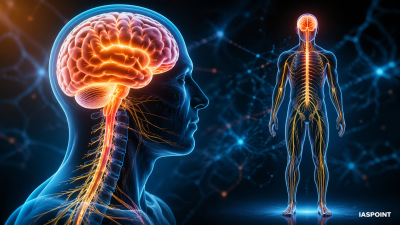
The Central Nervous System (CNS) serves as the processing center for the entire body. It consists of two primary structures: the Brain and the Spinal Cord. It is responsible for integrating sensory information and coordinating both conscious and unconscious activity. In the hierarchy of the nervous system, the CNS acts as the “Command Center,” while the Peripheral Nervous System (PNS) acts as the relay network.
Protective Mechanisms of the CNS
The CNS is highly delicate and is protected by a multi-layered defense system:
- Bony Armor: The brain is encased in the cranium (skull), and the spinal cord is protected by the vertebral column.
- Meninges: Three layers of connective tissue membranes:
- Dura Mater: The tough, outermost layer.
- Arachnoid Mater: The middle, web-like layer.
- Pia Mater: The thin, delicate innermost layer in direct contact with neural tissue.
- Cerebrospinal Fluid (CSF): A clear fluid circulating in the subarachnoid space and ventricles. It provides buoyancy, acts as a shock absorber, and facilitates nutrient-waste exchange.
- Blood-Brain Barrier (BBB): A highly selective semipermeable border that prevents harmful toxins and pathogens from entering the brain tissue from the bloodstream.
The Human Brain: Structure and Functional Anatomy
The brain is divided into three primary regions based on embryonic development: the Forebrain, Midbrain, and Hindbrain.
The Forebrain (Prosencephalon)
This is the most developed and largest part of the human brain.
- Cerebrum: Divided into left and right hemispheres connected by the Corpus Callosum (a tract of nerve fibers). The outer layer is the Cerebral Cortex (Gray Matter), and the inner part is White Matter.
- Frontal Lobe: Executive functions, motor control, and personality.
- Parietal Lobe: Processing sensory information (touch, temperature).
- Occipital Lobe: Visual processing.
- Temporal Lobe: Auditory processing and memory.
- Thalamus: Acts as a major relay station for sensory and motor signaling to the cerebral cortex.
- Hypothalamus: The master regulator of homeostasis. It controls body temperature, hunger, thirst, and the sleep-wake cycle. It also links the nervous system to the endocrine system via the Pituitary Gland.
The Midbrain (Mesencephalon)
Located between the thalamus and the hindbrain, it contains:
- Corpora Quadrigemina: Four rounded swellings involved in visual and auditory reflexes.
- Cerebral Aqueduct: A canal passing through the midbrain connecting ventricles.
The Hindbrain (Rhombencephalon)
Consists of the Pons, Cerebellum, and Medulla Oblongata.
- Cerebellum: The “Little Brain.” It coordinates voluntary movements, posture, and balance. It is highly sensitive to alcohol consumption.
- Pons: Acts as a bridge between various parts of the brain and contains centers that regulate respiration (Pneumotaxic center).
- Medulla Oblongata: The lowest part of the brain connecting to the spinal cord. It controls vital involuntary functions such as heartbeat, blood pressure, respiration, and gastric secretions.
The Spinal Cord
The spinal cord is a cylindrical bundle of nerve fibers extending from the medulla oblongata through the Foramen Magnum of the skull down the vertebral column.
- Gray and White Matter: Unlike the brain, the spinal cord has Gray Matter on the inside (H-shaped) and White Matter on the outside.
- Functions: It conducts sensory impulses from the body to the brain and motor impulses from the brain to the effectors. It is the primary center for Reflex Actions.
Functional Components: Gray Matter vs. White Matter
| Feature | Gray Matter | White Matter |
| Composition | Neuronal cell bodies, dendrites, and unmyelinated axons. | Predominantly myelinated axons. |
| Color Source | Capillaries and nerve cell bodies. | Myelin sheath (fatty substance). |
| Function | Information processing and signal integration. | Signal conduction and communication between brain regions. |
| Location (Brain) | Outer layer (Cortex). | Inner layer. |
| Location (Spinal Cord) | Inner core (H-shape). | Outer layer. |
Reflex Action and the Reflex Arc
A reflex action is an involuntary and nearly instantaneous movement in response to a stimulus. It bypasses conscious brain processing to ensure a rapid response.
- Pathway (Reflex Arc): Receptor → Sensory Neuron (Afferent) → Interneuron (in Spinal Cord) → Motor Neuron (Efferent) → Effector (Muscle/Gland).
- Example: Withdrawal of a hand upon touching a hot object.
Key Trivia and Facts for Prelims
- Average Brain Weight: Approximately 1.3 to 1.4 kg (about 2% of total body weight).
- Energy Consumption: The brain consumes nearly 20% of the body’s total oxygen and glucose.
- Nerve Impulse Speed: Can travel at speeds up to 120 meters per second.
- Neurogenesis: While most neurons are formed before birth, the Hippocampus is known for producing new neurons throughout life (associated with memory).
- Synapse: The functional junction between two neurons where chemical neurotransmitters (like Acetylcholine or Dopamine) transmit signals.
- Encephalitis: An acute inflammation of the brain, often caused by viral infections (e.g., Japanese Encephalitis).