

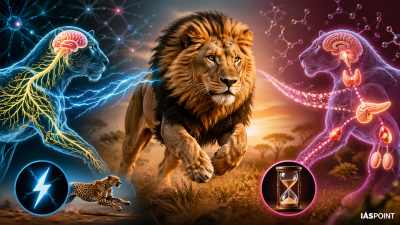
In the animal kingdom, coordination refers to the harmonious functioning of different body parts to perform a specific activity, while conduction is the transmission of signals (electrical or chemical) from one part of the body to another. This is achieved through two interconnected systems: the Nervous System (Rapid/Electrical) and the Endocrine System (Slow/Chemical).
Electrical Conduction via Nervous Tissue
Nervous tissue facilitates nearly instantaneous responses to environmental stimuli. The nature of conduction varies based on the anatomical complexity of the animal.
- Non-Polarized Conduction: In Cnidarians (Hydra), the nerve net consists of apolar neurons. An impulse generated at any point travels in all directions simultaneously, as there are no distinct axons or dendrites to direct the flow.
- Polarized Conduction: In higher invertebrates (Annelids, Arthropods) and all vertebrates, neurons are polarized. The impulse always flows from Dendrite → Cyton → Axon.
- Saltatory Conduction: Exclusive to myelinated nerve fibers (primarily in vertebrates). The electrical impulse “jumps” from one Node of Ranvier to the next, significantly increasing conduction velocity without requiring thick axons.
Chemical Coordination via Endocrine Tissues
Coordination is also managed by specialized glandular epithelial tissues that secrete hormones directly into the body fluids (blood or haemolymph).
| Animal Group | Key Coordination Fact | Example of Hormonal Action |
| Insects | Neurosecretory Cells | Ecdysone (molting hormone) and Juvenile Hormone coordinate growth and metamorphosis. |
| Crustaceans | X and Y Organs | Found in the eye-stalks of crabs/prawns; they regulate molting and sugar metabolism. |
| Amphibians | Metamorphosis | Thyroxine (from thyroid tissue) is essential for a tadpole to coordinate its transition into an adult frog. |
| Birds | Photoperiodism | The Pineal gland (nervous-endocrine tissue) coordinates migration and breeding cycles based on day length. |
Comparative Conduction Speeds
Conduction speed is a critical survival factor, particularly for escape responses in the wild.
- Squid Giant Axon: Achieves high-speed conduction (approx. 25 m/s) by having a massive diameter, which reduces internal electrical resistance.
- Vertebrate Myelinated Fibers: Achieve even higher speeds (up to 120 m/s) through insulation (myelin) rather than thickness, allowing for a compact yet highly efficient nervous system.
Sensory Coordination and Receptors
Tissues are organized into specialized sensory organs to receive external information (conduction of input).
- Mechanoreceptors: Detect touch and pressure. Examples include the Lateral Line System in fish and Statocysts in invertebrates for balance.
- Chemoreceptors: Detect chemical changes. Examples include Jacobson’s Organ in snakes (vomeronasal organ) used for “smelling” with the tongue.
- Photoreceptors: Detect light. Ranges from simple Ocelli (eye-spots) in flatworms to complex Compound Eyes in insects (composed of units called Ommatidia).
Neuromuscular Coordination
The point of contact where a motor neuron meets a muscle fiber is the Neuromuscular Junction (NMJ).
- Mechanism: When an electrical impulse reaches the NMJ, it triggers the release of the neurotransmitter Acetylcholine.
- Response: This chemical signal causes the muscular tissue to contract. In non-human animals, this coordination is refined for specific needs, such as the rapid reflex of a frog’s tongue or the precise flight maneuvers of a hawk.
Important Facts for UPSC Prelims
- Reflex Action: An involuntary and nearly instantaneous movement in response to a stimulus. The “Reflex Arc” involves a sensory neuron, an interneuron (in the spinal cord/ganglion), and a motor neuron.
- Neurotransmitters: Common ones include Acetylcholine and Adrenaline. In many invertebrates, Octopamine plays a role similar to adrenaline in vertebrates, coordinating “fight or flight” responses.
- Pheromones: These are chemical signals secreted by exocrine glands that coordinate behavior between individuals of the same species (e.g., trail-following in ants or mate-attraction in moths).
- Thermal Coordination: Ectothermic animals (reptiles/amphibians) coordinate their metabolic activity with external temperature. Their nervous tissue can function at lower temperatures, but their chemical conduction (enzymatic/hormonal) slows down in the cold.