

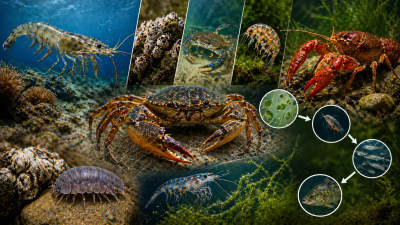
Crustaceans constitute a large, diverse subphylum of Phylum Arthropoda. While most arthropods are terrestrial (like insects and arachnids), crustaceans are primarily aquatic, inhabiting both marine and freshwater environments. They serve as a vital link in the aquatic food chain, acting as primary consumers of algae and as a food source for higher vertebrates.
Distinctive Anatomical Features
The morphology of crustaceans is characterized by several key evolutionary adaptations that distinguish them from other arthropod classes like Insecta or Myriapoda.
Body Segmentation and Tagmosis
- Cephalothorax: In most higher crustaceans, the head and thorax are fused to form a single unit called the cephalothorax.
- Carapace: This is a shield-like plate of the exoskeleton that covers the cephalothorax, providing protection to vital organs and the gill chambers.
- Abdomen: The posterior part of the body, often segmented and muscular, ending in a tail-like structure called the telson and uropods for swimming.
Appendages and Senses
- Biramous Appendages: A defining characteristic where limbs branch into two parts (exopodite and endopodite).
- Antennae: Crustaceans are the only arthropods with two pairs of antennae (antennules and antennae), used for chemoreception and tactile sensing.
- Compound Eyes: Most possess stalked compound eyes that provide a wide field of vision, essential for predator detection in murky waters.
Physiological Systems and Survival Mechanisms
| System | Description |
| Exoskeleton | Composed of Chitin hardened with Calcium Carbonate (calcification), necessitating periodic molting (Ecdysis) for growth. |
| Respiration | Most use Gills (branchiae) located near the leg bases; smaller species may breathe through the body surface. |
| Excretion | Waste is removed via specialized Green Glands (antennal glands) located at the base of the antennae. |
| Circulation | An Open Circulatory System where hemolymph (blood) bathes organs directly in a hemocoel. |
Classification and Diversity
Crustaceans are categorized based on limb structure and body plan. The following table highlights the major classes relevant to biological studies.
| Class | Common Examples | Key Features |
| Malacostraca | Crabs, Lobsters, Shrimp, Woodlice | Largest class; fixed number of body segments (19-20). |
| Maxillopoda | Barnacles, Copepods | Often lack typical legs; barnacles are sessile (fixed) adults. |
| Branchiopoda | Fairy Shrimp, Water Fleas (Daphnia) | Use flattened, leaf-like legs for both respiration and filter feeding. |
| Ostracoda | Seed Shrimp | Body entirely enclosed in a bivalve-like calcareous shell. |
Life Cycle and Reproduction
Reproductive Strategies
- Dioecious Nature: Most species have separate sexes.
- Internal Fertilization: Common in most species, though barnacles (which are hermaphroditic) also utilize internal fertilization.
- Parthenogenesis: Some species, like certain water fleas, can reproduce without fertilization when environmental conditions are favorable.
Developmental Stages
Most crustaceans undergo indirect development involving several larval stages.
- Nauplius Larva: The most basic and common earliest larval stage, characterized by an unsegmented body and three pairs of appendages.
- Zoea and Megalopa: Advanced larval stages specifically seen in crabs and lobsters before reaching adulthood.
Ecological and Economic Importance
Role in the Ecosystem
- Filter Feeders: Small crustaceans like krill and copepods filter phytoplankton, converting solar energy into animal protein.
- Scavengers: Larger crustaceans (crabs and lobsters) act as “underwater janitors,” consuming detritus and decaying organic matter.
- Keystone Species: Krill are the primary food source for Antarctic whales, seals, and penguins.
Economic Impact
- Fisheries: Prawns, shrimps, and crabs form a multi-billion dollar global industry.
- Bio-indicators: The presence or absence of certain crustacean species (like Daphnia) indicates the health and pollution levels of freshwater bodies.
UPSC Trivia: Quick Facts for Prelims
- Largest Crustacean: The Japanese Spider Crab, with a leg span of up to 3.8 meters.
- Smallest Crustacean: Certain species of tantulocaridans, measuring less than 0.1 mm.
- Terrestrial Exception: Woodlice (Sowbugs) are one of the few crustacean groups that have successfully adapted to life on land, though they still require moist environments to breathe through their modified pleopods.
- Blue Blood: Many crustaceans use Hemocyanin (copper-based) instead of Hemoglobin (iron-based) to transport oxygen, giving their blood a bluish tint.
- Decapoda: An order within Malacostraca (including crabs and shrimp) characterized by having ten legs (five pairs of thoracic appendages).