

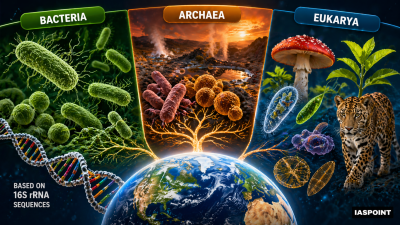
The Three Domain System is a biological classification introduced by Carl Woese in 1990. It represents a level of classification higher than the Kingdom, known as the Domain. This system emphasizes the molecular differences between organisms, specifically focusing on the sequences of 16S ribosomal RNA (rRNA). While Whittaker’s Five Kingdom system focuses on morphology and nutrition, the Three Domain system reflects the evolutionary history (phylogeny) of life more accurately.
The Three Domains of Life
The system divides all living organisms into three distinct domains: Archaea, Bacteria, and Eukarya.
1. Domain Archaea (Archaebacteria)
Archaea are prokaryotic cells that lack a nuclear membrane. Although they look like bacteria under a microscope, they possess unique biochemical and genetic traits.
- Cell Membrane: Composed of branched-chain lipids linked to glycerol by ether linkages, providing extreme stability.
- Genetics: Their transcription and translation processes are more similar to Eukaryotes than to Bacteria.
- Environmental Niche: They are often extremophiles, living in environments where most life cannot survive.
- Methanogens: Produce methane; found in marshy areas and the gut of ruminants (cows, buffaloes).
- Halophiles: Live in extremely salty environments like the Great Salt Lake.
- Thermoacidophiles: Survive in hot, acidic environments like sulfur springs.
2. Domain Bacteria (Eubacteria)
This domain consists of “true” bacteria. They are prokaryotic and are the most diverse and widespread organisms on Earth.
- Cell Wall: Contains peptidoglycan (a feature absent in Archaea and Eukaryotes).
- Nutrition: Includes photoautotrophs (Cyanobacteria), chemoautotrophs (Nitrosomonas), and heterotrophs (Decomposers/Pathogens).
- Significance: Responsible for nutrient cycling (nitrogen fixation), decomposition, and many human diseases.
3. Domain Eukarya (Eukaryotes)
This domain includes all organisms that possess a well-defined nucleus and membrane-bound organelles. It encompasses four of Whittaker’s five kingdoms.
- Kingdom Protista: Unicellular eukaryotes (e.g., Amoeba, Algae).
- Kingdom Fungi: Saprophytic multicellular organisms (e.g., Mushrooms, Yeast).
- Kingdom Plantae: Multicellular autotrophs (e.g., Mosses, Ferns, Flowering plants).
- Kingdom Animalia: Multicellular heterotrophs (e.g., Insects, Fish, Humans).
Comparison of the Three Domains
The following table highlights the fundamental differences used to distinguish these domains:
| Characteristic | Domain Bacteria | Domain Archaea | Domain Eukarya |
| Cell Type | Prokaryotic | Prokaryotic | Eukaryotic |
| Cell Wall | Contains Peptidoglycan | Lacks Peptidoglycan | Cellulose or Chitin (if present) |
| Membrane Lipids | Unbranched (Ester-linked) | Branched (Ether-linked) | Unbranched (Ester-linked) |
| RNA Polymerase | One simple type | Several complex types | Several complex types |
| Introns (in DNA) | Rare | Present in some genes | Present in most genes |
| Antibiotic Sensitivity | Sensitive | Not sensitive | Not sensitive |
Relationship with the Six Kingdom System
The Three Domain system effectively expands the Five Kingdom system into a Six Kingdom System. Under this model:
- Kingdom Monera is split into two: Kingdom Archaebacteria and Kingdom Eubacteria.
- The other four kingdoms (Protista, Fungi, Plantae, Animalia) remain grouped under the Domain Eukarya.
UPSC Prelims Fact File: Key Takeaways
- The Molecular Clock: Carl Woese used 16S rRNA because it is present in all living organisms and evolves very slowly, making it an excellent “chronometer” for tracing ancient evolutionary history.
- Ether vs. Ester: The ether bonds in Archaea cell membranes are much stronger than the ester bonds in Bacteria and Eukarya, which is why Archaea can survive in boiling water or volcanic vents.
- Peptidoglycan: Its presence is a definitive test for identifying Domain Bacteria.
- Horizontal Gene Transfer (HGT): The Three Domain system acknowledges that genes can move between different species, complicating the “Tree of Life” and making it more like a “Web of Life.”