

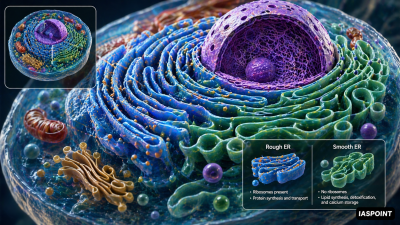
The Endoplasmic Reticulum (ER) is a continuous membrane system that forms a series of flattened sacs within the cytoplasm of eukaryotic cells. Discovered by Keith Porter in 1945, it serves as the cell’s primary manufacturing and transport facility. It is part of the endomembrane system, physically connected to the nuclear envelope and extending throughout the cytosol.
Structural Classification and Differences
The ER is classified into two distinct types based on the presence or absence of ribosomes on its surface. While they are physically connected, they perform vastly different physiological functions.
| Feature | Rough Endoplasmic Reticulum (RER) | Smooth Endoplasmic Reticulum (SER) |
| Appearance | Studded with ribosomes (granular) | Lacks ribosomes (agranular) |
| Primary Component | Composed mainly of cisternae (flattened sacs) | Composed mainly of tubules |
| Location | Usually found near the nucleus | Found near the cell membrane |
| Primary Function | Protein synthesis and folding | Lipid synthesis and detoxification |
| Abundance | High in pancreatic cells (enzymes) | High in liver and gonadal cells |
Functions of the Rough Endoplasmic Reticulum (RER)
Protein Synthesis and Quality Control
The RER is the primary site for the synthesis of proteins destined for secretion, membrane integration, or lysosomal enzymes. Ribosomes attached to the RER translate mRNA into polypeptide chains that enter the ER lumen.
- Protein Folding: Inside the lumen, “chaperone” proteins assist in folding the polypeptides into their functional 3D shapes.
- Glycosylation: The RER initiates the process of adding carbohydrate chains to proteins, creating glycoproteins.
- Quality Check: Misfolded proteins are identified and sent back to the cytosol for degradation (a process known as ER-associated degradation or ERAD).
Functions of the Smooth Endoplasmic Reticulum (SER)
Lipid and Steroid Synthesis
The SER is responsible for the production of essential lipids, including phospholipids and cholesterol, which are vital for maintaining the plasma membrane.
- Hormone Production: In animal cells, the SER is the site where steroid hormones (like estrogen and testosterone) are synthesized from cholesterol.
- Sarcoplasmic Reticulum: In muscle cells, a specialized form of SER called the sarcoplasmic reticulum stores and releases Calcium ions (Ca2+), which are critical for muscle contraction.
Detoxification and Metabolism
The SER plays a pivotal role in the liver’s ability to neutralize toxins.
- Drug Detoxification: It contains enzymes (such as Cytochrome P450) that convert lipid-soluble drugs and metabolic wastes into water-soluble substances for excretion.
- Carbohydrate Metabolism: The SER contains the enzyme Glucose-6-phosphatase, which is essential for gluconeogenesis and the breakdown of glycogen into glucose in the liver.
Essential Facts for UPSC Prelims
The Endomembrane System
The ER does not work in isolation. It forms a functional unit with the Golgi Apparatus, Lysosomes, and Vacuoles. Proteins synthesized in the RER are packaged into transport vesicles that “bud off” and fuse with the Golgi apparatus for further processing and “address tagging.”
Presence and Absence across Life Forms
- Eukaryotes: Present in all eukaryotic cells (plants, animals, fungi, protists).
- Prokaryotes: Absent in bacteria and archaea; prokaryotes lack membrane-bound organelles.
- Mammalian Red Blood Cells (RBCs): Mature human RBCs lack an ER to maximize space for hemoglobin and oxygen transport.
Key Terminology and Trivia
- Cisternae: The sac-like structures of the ER that increase surface area for chemical reactions.
- Lumen: The internal space of the ER, distinct from the surrounding cytosol.
- Ergastoplasm: A term sometimes used in histology to describe the ribosome-rich, intensely staining regions of the RER.
- Microsomes: These are not found in living cells; they are small vesicle-like fragments of the ER formed when cells are homogenized in a laboratory setting.
Clinical and Biological Significance
ER Stress and Disease
If the protein-folding capacity of the ER is overwhelmed, “ER Stress” occurs. The cell triggers the Unfolded Protein Response (UPR). Chronic ER stress is linked to several human diseases, including Type 2 Diabetes, Alzheimer’s, and various neurodegenerative disorders, where misfolded proteins accumulate.
Evolutionary Context
The ER is theorized to have evolved from the invagination (folding inward) of the plasma membrane, a process that also likely created the nuclear envelope, explaining why the two membranes are continuous.
Last Modified: April 22, 2026