

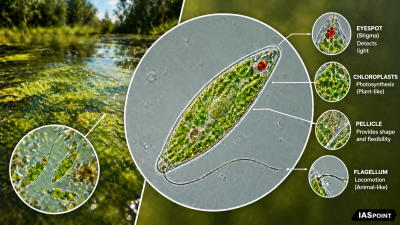
Euglenoids are a group of unicellular flagellate protists primarily found in stagnant fresh water. They are unique biological entities because they exhibit characteristics of both plants and animals, making them a “link” between the two kingdoms.
Distinctive Cellular Structure
Unlike most other photosynthetic organisms, euglenoids possess a flexible body structure.
- Pellicle: Instead of a rigid cellulose cell wall, they have a protein-rich layer called a pellicle. This layer makes their body flexible, allowing them to change shape (a movement known as metaboly).
- Flagella: They typically possess two flagella—one short and one long—used for locomotion.
- Stigma (Eye-spot): They have a pigmented spot called the stigma that is sensitive to light, helping the organism move toward light sources for photosynthesis.
Dual Mode of Nutrition (Mixotrophy)
The most notable feature of euglenoids is their ability to switch nutritional modes based on environmental conditions.
- Photosynthetic (Holophytic): In the presence of sunlight, they perform photosynthesis using pigments (Chlorophyll a and b) identical to those found in higher plants.
- Heterotrophic (Holozoic): When deprived of sunlight, they behave like heterotrophs by predating on smaller organisms or absorbing organic nutrients from the water.
- Storage Product: The food synthesized during photosynthesis is stored as Paramylon, a unique carbohydrate (β-1,3-glucan) different from starch or glycogen.
Classification and Ecological Role
Euglenoids belong to the Kingdom Protista and the Phylum Euglenophyta.
- Habitat: Predominantly found in freshwater bodies like ponds, pools, and ditches, especially those rich in organic matter.
- Environmental Indicators: Certain species like Euglena viridis are indicators of organic pollution in water (Eutrophication).
- Reproduction: They primarily reproduce asexually through longitudinal binary fission. They do not show typical sexual reproduction.
Comparison: Euglenoids vs. Other Protists
| Feature | Euglenoids | Diatoms (Chrysophytes) | Dinoflagellates |
| Cell Wall | Absent (Pellicle present) | Siliceous (Soap-box) | Cellulosic Plates |
| Flagella | Two (Unequal length) | Mostly absent in vegetative phase | Two (One longitudinal, one transverse) |
| Nutrition | Mixotrophic | Autotrophic | Autotrophic/Heterotrophic |
| Habitat | Stagnant Fresh Water | Marine and Fresh Water | Mostly Marine |
Key Facts for UPSC Prelims
- Connecting Link: Euglenoids are often cited as a transitional group between plants (due to chlorophyll) and animals (due to lack of cell wall and heterotrophic behavior).
- Pigment Composition: They contain Chlorophyll a and b, which is a specific trait they share with green algae and higher land plants, suggesting an evolutionary link.
- Contractile Vacuole: They possess a contractile vacuole that functions in osmoregulation, expelling excess water from the cell—a feature common in freshwater protozoans.
- Taxonomic Ambiguity: Historically, botanists classified them as algae (Euglenophyta) while zoologists classified them as protozoans (Euglenoidina). Under the five-kingdom classification, they are placed firmly in Protista.