

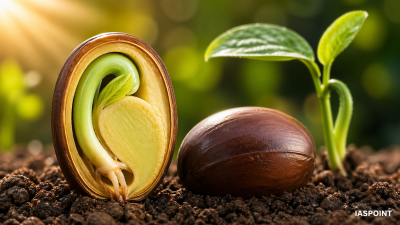
A seed is a fertilized, mature ovule that contains an embryonic plant and stored food, protected by a protective coat. It represents the final product of sexual reproduction in angiosperms and gymnosperms.
Structural Components of a Seed
Every seed typically consists of three fundamental parts:
- Seed Coat: The outer protective covering developed from the integuments of the ovule. It consists of an outer tough layer called the testa and an inner papery layer called the tegmen.
- Hilum: A scar on the seed coat through which the developing seed was attached to the fruit (via the funicle).
- Micropyle: A small pore above the hilum that facilitates the entry of oxygen and water during germination.
- Embryo: The most vital part, consisting of an embryonal axis (radicle and plumule) and one or two cotyledons.
- Radicle: The embryonic root.
- Plumule: The embryonic shoot.
Classification Based on the Number of Cotyledons
Seeds are primarily classified into two groups based on the number of embryonic leaves (cotyledons) present.
Dicotyledonous Seeds (Dicots)
These seeds possess two cotyledons. The cotyledons are often fleshy and full of reserve food materials.
- Structure: The embryonal axis consists of the hypocotyl (region below cotyledons ending in the radicle) and epicotyl (region above cotyledons ending in the plumule).
- Examples: Pea, Gram, Bean, Mustard, Mango.
Monocotyledonous Seeds (Monocots)
These seeds possess only one cotyledon. In the grass family (Poaceae), this single cotyledon is large and shield-shaped, known as the scutellum.
- Structure: The radicle and plumule are enclosed in protective sheaths called coleorhiza and coleoptile, respectively.
- Examples: Maize, Wheat, Rice, Coconut.
Classification Based on Endosperm Presence
The endosperm is a nutrient-rich tissue formed during double fertilization. Seeds are categorized by whether they retain this tissue at maturity.
| Type | Characteristics | Examples |
| Endospermic (Albuminous) | Endosperm is retained as a food storage tissue at maturity. Common in monocots. | Wheat, Maize, Barley, Castor (Dicot exception), Coconut. |
| Non-Endospermic (Exalbuminous) | Endosperm is consumed during embryo development; food is stored in cotyledons. | Pea, Bean, Gram, Groundnut, Orchids (Monocot exception). |
Seed Germination and Dormancy
- Dormancy: A state of “suspended animation” where the embryo remains inactive despite favorable conditions. This is often due to hard seed coats or internal chemical inhibitors (like Abscisic Acid).
- Epigeal Germination: The cotyledons are pushed above the soil surface due to the rapid elongation of the hypocotyl. Example: Bean, Castor, Cotton.
- Hypogeal Germination: The cotyledons remain below the soil surface because the epicotyl elongates. Example: Pea, Gram, Maize.
UPSC Prelims Fact File: Seeds
- Orchid Seeds: These are among the smallest and lightest seeds in the world, often described as “dust seeds.”
- Double Coconut (Lodoicea maldivica): Produces the largest and heaviest seed in the plant kingdom.
- Perisperm: In some seeds like Black Pepper and Beet, remnants of the nucellus persist; this persistent nucellus is called perisperm.
- Viability: The period for which a seed retains the ability to germinate. Records include Lupinus arcticus (reclaimed from Arctic tundra, germinated after approx. 10,000 years) and Phoenix dactylifera (Date palm, 2,000-year-old viable seed found near the Dead Sea).
- Seed Banks: Facilities like the Svalbard Global Seed Vault and India’s National Gene Bank (NBPGR) are critical for preserving genetic diversity against climate change and extinction.