

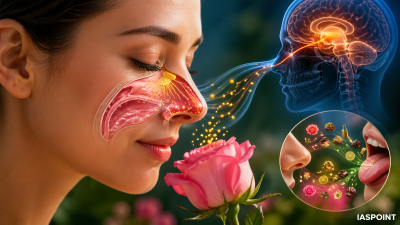
The nose acts as the primary organ for Olfaction (smell). In humans, this sense is highly sensitive, capable of detecting thousands of different odors, and is chemically linked to the sense of taste.
1. Anatomical Structure of the Olfactory Apparatus
The olfactory receptors are located in the upper part of the nasal cavity, covering a small patch of tissue known as the Olfactory Epithelium.
- Olfactory Epithelium: A specialized epithelial tissue consisting of three types of cells:
- Olfactory Receptor Cells: Bipolar neurons that act as the primary chemoreceptors.
- Supporting Cells: Provide physical support and nourishment to the receptors.
- Basal Cells: Stem cells that periodically replace the olfactory neurons (one of the few instances of neuronal regeneration in adults).
- Mucus Layer: Produced by Bowman’s Glands, this layer dissolves volatile odorant molecules so they can interact with the receptor cilia.
2. Mechanism of Olfaction (Smell Transduction)
Olfaction is a chemical sense. The process follows a specific biochemical sequence:
- Detection: Volatile chemical molecules enter the nasal cavity and dissolve in the mucus.
- Binding: These chemicals bind to specific protein receptors on the Cilia (hair-like projections) of the olfactory neurons.
- Depolarization: The binding triggers a second messenger system (involving cAMP), which opens ion channels and generates a nerve impulse.
- Olfactory Bulb: The axons of the olfactory neurons pass through the Cribriform Plate of the ethmoid bone and synapse in the Olfactory Bulb, an extension of the brain.
3. Neural Pathway and the Limbic System
The olfactory pathway is unique among sensory systems because it is the only sense that bypasses the Thalamus and goes directly to the primary sensory cortex and the Limbic System.
- Limbic Connection: This direct link to the Amygdala and Hippocampus explains why certain smells can trigger intense emotional responses or vivid memories (known as the “Proustian Effect”).
- Integration: The brain integrates smell with taste to create the perception of Flavor. This is why food tastes “bland” when the nose is blocked during a common cold.
4. Classification of Smells
While there is no universally accepted “primary odor” list (unlike the five primary tastes), smells are often categorized into groups such as:
- Floral (Roses)
- Ethereal (Cleaning fluid)
- Musky (Perfumes)
- Camphoraceous (Mothballs)
- Putrid (Rotting food)
- Pungent (Vinegar)
Comparative Summary Table
| Feature | Olfactory System (Smell) |
| Receptor Type | Chemoreceptor |
| Stimulus | Volatile, lipid-soluble chemicals |
| Primary Nerve | Olfactory Nerve (I Cranial Nerve) |
| Regeneration | Neurons are replaced every 30–60 days |
| Brain Destination | Olfactory Cortex and Limbic System |
Key Facts for UPSC Prelims
- Anosmia: The total loss of the sense of smell. It gained significant attention as a clinical symptom of COVID-19.
- Vomeronasal Organ (Jacobson’s Organ): A specialized organ found in many animals (like snakes and cats) to detect Pheromones. In humans, it is vestigial (non-functional).
- Chemical Nature: To be smelled, a substance must be volatile (easily vaporized) and at least slightly water-soluble (to dissolve in mucus).
- Adaptation: The olfactory sense adapts very quickly. You may notice a strong odor upon entering a room, but within minutes, the receptors stop signaling its presence to the brain.
Trivia and Scientific Context
- Macrosmatic vs. Microsmatic: Animals with a highly developed sense of smell (like dogs) are called Macrosmatic, while humans, whose sense of smell is less critical for survival, are Microsmatic.
- Olfactory Fatigue: This is a temporary, normal inability to distinguish a particular odor after prolonged exposure to it.