

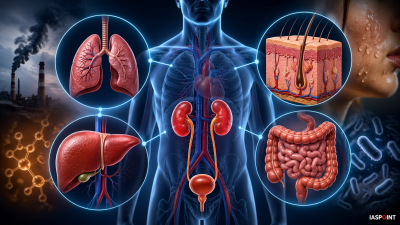
Excretion is the biological process by which an organism eliminates metabolic waste products from its body. In humans, while the kidneys are the primary organs of the urinary system, several other organs participate in the excretory process to maintain homeostasis and osmoregulation. These organs filter or transform toxic substances like urea, uric acid, ammonia, and excess salts.
The Primary Organ: The Kidney
The kidneys are the chief components of the human excretory system, responsible for filtering blood and forming urine.
Structural and Functional Facts
- Location: Situated between the levels of the last thoracic and third lumbar vertebra.
- Nephrons: Each kidney contains approximately one million complex tubular structures called nephrons, which are the functional units.
- Glomerular Filtration Rate (GFR): A healthy individual has a GFR of approximately 125 ml/minute (180 liters per day).
- Urine Composition: Typically consists of 95% water and 5% organic and inorganic waste (urea, creatinine, ammonia, and sodium/potassium salts).
Accessory Organs of Excretion
Beyond the kidneys, the lungs, liver, and skin play vital roles in removing metabolic by-products that cannot be handled by the renal system alone.
1. The Lungs
The lungs are responsible for the elimination of gaseous wastes produced during cellular respiration.
- Carbon Dioxide (CO2): Humans eliminate approximately 18 liters of CO2 per hour.
- Water Vapor: Significant amounts of water are lost through evaporation during exhalation.
2. The Liver
The liver is the largest gland in the body and acts as a chemical processing plant.
- Urea Synthesis: It converts highly toxic ammonia into less toxic urea via the Ornithine Cycle (Urea Cycle).
- Bile Pigments: It excretes bilirubin, biliverdin, cholesterol, degraded steroid hormones, vitamins, and drugs via bile.
- Detoxification: It neutralizes heavy metals and toxins, which are then excreted through the digestive tract or kidneys.
3. The Skin
The skin possesses two types of glands that contribute to the excretory load.
- Sweat Glands: Primarily used for thermoregulation, sweat contains water, NaCl, small amounts of urea, and lactic acid.
- Sebaceous Glands: These eliminate certain substances like sterols, hydrocarbons, and waxes through sebum, providing a protective oily covering for the skin.
Comparative Analysis of Excretory Products
| Organ | Major Waste Excreted | Process/Mechanism |
| Kidneys | Urea, Uric acid, Excess salts, Water | Ultrafiltration and Selective Reabsorption |
| Lungs | Carbon Dioxide (CO2), Water vapor | Diffusion during Respiration |
| Liver | Bilirubin, Biliverdin, Cholesterol, Urea | Ornithine Cycle and Bile secretion |
| Skin | NaCl, Lactic acid, Urea (trace), Sterols | Perspiration (Sweat) and Sebum |
| Intestine | Salts of heavy metals, Calcium, Undigested food | Defecation |
Nitrogenous Waste Types in the Animal Kingdom
For UPSC Prelims, it is essential to distinguish how different organisms handle nitrogenous waste based on their habitat and water availability.
Ammonotelism
- Waste: Ammonia.
- Properties: Highly toxic; requires large amounts of water for elimination.
- Examples: Bony fishes, aquatic amphibians, and aquatic insects.
Ureotelism
- Waste: Urea.
- Properties: Less toxic; requires moderate water. Ammonia is converted to urea in the liver.
- Examples: Mammals, terrestrial amphibians, and marine fishes.
Uricotelism
- Waste: Uric Acid.
- Properties: Least toxic; excreted as pellets or paste with minimum water loss.
- Examples: Reptiles, birds, land snails, and insects.
Key Trivia for Prelims
- Micturition: The process of release of urine; it is regulated by the central nervous system via the micturition reflex.
- Glycosuria and Ketonuria: The presence of glucose and ketone bodies in urine is a clinical indicator of Diabetes Mellitus.
- Renal Calculi: Stones or insoluble masses of crystallized salts (usually calcium oxalates) formed within the kidney.
- Hemodialysis: An artificial process to remove nitrogenous waste when kidneys fail. Blood is drained from a convenient artery and pumped into a dialyzing unit after adding an anticoagulant like heparin.
- ADH (Antidiuretic Hormone): Also known as Vasopressin, it facilitates water reabsorption from the distal parts of the tubule, thereby preventing diuresis (excessive urination).