

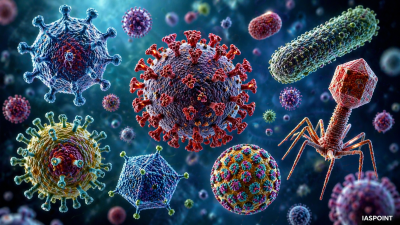
Viruses are unique biological entities that exist on the threshold between living and non-living matter.
Core Components of a Virus
- Genetic Material: Viruses contain either DNA or RNA, but never both. This genome can be single-stranded (ss) or double-stranded (ds).
- Capsid: A protective protein shell that encloses the genetic material. It is composed of subunits called capsomeres.
- Envelope: Some viruses (like HIV or SARS-CoV-2) have an outer lipid membrane derived from the host cell’s membrane. These are “enveloped” viruses, while those without are “naked.”
Classification of Viruses
Viruses are classified based on their host range and the type of nucleic acid they carry.
Based on Host Type
- Phytophagineae (Plant Viruses): These generally have single-stranded RNA (ssRNA). Example: Tobacco Mosaic Virus (TMV).
- Zoophagineae (Animal Viruses): These may contain either DNA or RNA (single or double-stranded). Examples: Influenza, Polio, Mumps, and Herpes.
- Bacteriophages: Viruses that specifically infect and kill bacteria. They typically possess double-stranded DNA (dsDNA). They are often tadpole-shaped with a head and a tail.
Based on Genetic Material
- DNA Viruses: Examples include Smallpox (Variola), Chickenpox (Varicella), and Hepatitis B.
- RNA Viruses: These include most plant viruses and many human pathogens like Ebola, SARS-CoV-2, and Rabies.
- Retroviruses: A specialized group of RNA viruses that use the enzyme Reverse Transcriptase to convert their RNA into DNA inside the host cell (e.g., HIV).
Viral Life Cycle and Replication
Viruses do not undergo binary fission like bacteria. Instead, they hijack the host’s molecular machinery to produce viral components.
- Attachment: The virus binds to specific receptors on the host cell surface.
- Penetration: The virus or its genetic material enters the host cell.
- Biosynthesis: The host cell’s ribosomes and enzymes are forced to synthesize viral proteins and nucleic acids.
- Maturation: New viral particles are assembled.
- Release: New virions exit the cell, often causing the host cell to burst (lysis).
Comparative Analysis: Distinct Infectious Agents
| Agent | Composition | Target/Effect |
| Virus | Protein coat + DNA or RNA | Animals, Plants, Bacteria |
| Viroid | Free RNA (No protein coat) | Primarily plants (e.g., Potato Spindle Tuber) |
| Prion | Abnormally folded proteins | Nervous system (e.g., Mad Cow Disease) |
| Virion | Entire infectious virus particle | Extracellular stage of the virus |
Significant Viral Diseases and Vectors
Understanding the mode of transmission is crucial for UPSC Prelims Geography and Science & Technology sections.
- Zoonotic Diseases: Viruses that jump from animals to humans (e.g., Nipah, Ebola, Avian Flu).
- Vector-Borne Viral Diseases:
- Aedes aegypti mosquito: Transmits Dengue, Chikungunya, Zika, and Yellow Fever.
- Culex mosquito: Transmits Japanese Encephalitis.
- Notable Human Viruses:
- Hepatitis: B and C are blood-borne; A and E are generally water-borne.
- Human Papillomavirus (HPV): Linked to cervical cancer; preventable via vaccination.
Technical Trivia for UPSC
- Interferons: These are proteins produced by host cells in response to a viral infection. They “interfere” with viral replication and warn neighboring cells.
- First Virus Discovered: The Tobacco Mosaic Virus (TMV) was the first virus to be identified, following the work of Dmitri Ivanovsky and Martinus Beijerinck.
- Vaccine Mechanism: Vaccines stimulate the immune system to recognize specific viral proteins (antigens) without causing the disease itself.
- Bacteriophages in Ganga: The presence of bacteriophages (specifically Bdellovibrio) is often cited as a reason for the self-purifying property of the Ganga river water, as they consume pathogenic bacteria.
Viral Applications in Biotechnology
- Gene Therapy: Modified, non-pathogenic viruses are used as vectors to deliver healthy genes into human cells to treat genetic disorders.
- Vaccine Development: Viral vectors are used in vaccines (e.g., the AstraZeneca/Covishield vaccine used an Adenovirus vector).
- Phage Therapy: Using bacteriophages to treat bacterial infections, especially those resistant to antibiotics (Multi-Drug Resistance).