

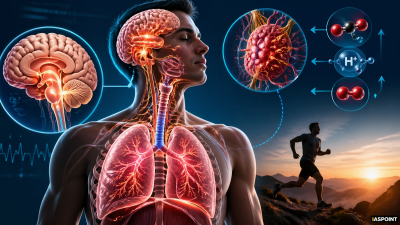
The human body possesses a highly sophisticated ability to maintain and moderate the respiratory rhythm to suit the demands of the body tissues. This regulation is primarily achieved through the nervous system and chemical sensors (chemoreceptors), which monitor the levels of CO2, H^+ ions, and to a much lesser extent, O2.
Neural Regulation of Breathing
The primary control of breathing is involuntary and resides in the brainstem.
Respiratory Rhythm Center
- Location: Located in the Medulla Oblongata.
- Function: It is the primary center responsible for the basic rhythm of respiration. It sends periodic impulses to the diaphragm and intercostal muscles to initiate inspiration.
Pneumotaxic Center
- Location: Located in the Pons region of the brain.
- Function: It acts as a “switch-off” point for inspiration. By sending inhibitory signals to the Medulla, it limits the duration of inspiration, thereby increasing the rate of breathing.
- Significance: This center ensures the lungs do not over-inflate and coordinates the transition between inhalation and exhalation.
Chemical Regulation (Chemoreceptors)
The respiratory system is more sensitive to changes in waste products (CO2) than to the lack of oxygen (O2).
Central Chemoreceptors
- Location: Situated in the Medulla, adjacent to the respiratory rhythm center.
- Sensitivity: Highly sensitive to changes in CO2 and Hydrogen ion (H^+) concentration.
- Mechanism: An increase in these substances activates this center, which then signals the rhythm center to increase the breathing rate to eliminate these gases.
Peripheral Chemoreceptors
- Location: Found in the Aortic Arch and the Carotid Arteries.
- Function: They monitor the chemical composition of arterial blood.
- Trigger: Like central receptors, they recognize changes in pCO2 and H^+ concentration and send necessary signals to the Medulla for corrective action.
Role of Different Gases: The UPSC Fact Check
- Carbon Dioxide (CO2): The primary driver of respiration. Even a slight increase in pCO2 triggers a strong respiratory response.
- Hydrogen Ions (H^+): Reflects the acidity (pH) of the blood. High H^+ (low pH) stimulates faster breathing to “wash out” CO2.
- Oxygen (O2): Surprisingly, the role of oxygen in the regular regulation of respiratory rhythm is quite insignificant. The body only reacts to oxygen levels when they drop to dangerously low levels (hypoxia).
Factors Influencing Breathing Rate
| Factor | Effect on Breathing Rate | Reason |
| Exercise | Increases | Higher CO2 production and O2 demand in muscles. |
| High Altitude | Increases | Low partial pressure of oxygen (pO2) in the atmosphere. |
| Fear/Anxiety | Increases | Adrenaline prepares the body for “fight or flight.” |
| Sleep | Decreases | Lower metabolic rate and CO2 production. |
Important Clinical and Biological Trivia
- Hering-Breuer Reflex: A protective mechanism that prevents over-inflation of the lungs. Stretch receptors in the walls of the bronchi and bronchioles send inhibitory signals to the Medulla when the lungs are overstretched.
- Mountain Sickness: At high altitudes, low pO2 causes nausea, fatigue, and palpitations. The body compensates by increasing the breathing rate and, over time, increasing RBC production (Polycythemia).
- Voluntary Control: While the Medulla handles involuntary breathing, the Cerebral Cortex allows for voluntary control (e.g., holding one’s breath or singing), though this can be overridden by the Medulla if CO2 levels become too high.