

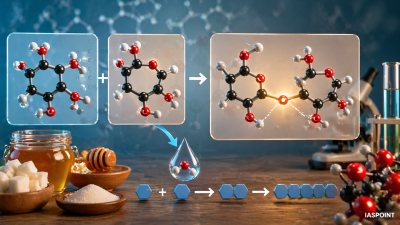
Disaccharides are a class of carbohydrates formed when two monosaccharide units (monomers) undergo a dehydration reaction (also known as a condensation reaction). During this process, a molecule of water is eliminated, and a covalent bond known as a glycosidic bond is formed between the two sugar molecules.
The Glycosidic Bond
The glycosidic bond is the characteristic linkage in disaccharides and polysaccharides.
- It usually forms between the anomeric carbon (C-1) of one monosaccharide and a hydroxyl group (often at C-4) of the second monosaccharide.
- Alpha (α) linkage: Formed when the OH group on the first carbon is below the plane of the ring.
- Beta (β) linkage: Formed when the OH group is above the plane of the ring.
Major Disaccharides and Their Composition
| Disaccharide | Monosaccharide Units | Common Name | Source/Occurrence |
| Sucrose | Glucose + Fructose | Table Sugar / Cane Sugar | Sugarcane, sugar beets, and many fruits. |
| Lactose | Glucose + Galactose | Milk Sugar | Mammalian milk (approx. 4–6%). |
| Maltose | Glucose + Glucose | Malt Sugar | Germinating seeds and starch digestion. |
Reducing vs. Non-Reducing Disaccharides
The ability of a sugar to act as a reducing agent depends on the presence of a free aldehyde or ketone group (anomeric carbon).
Sucrose: The Non-Reducing Sugar
Sucrose is unique because the glycosidic bond forms between the reducing ends of both glucose and fructose.
- Since both “active” groups are tied up in the bond, sucrose cannot reduce alkaline solutions of copper (Benedict’s/Fehling’s solution).
- It is the primary form in which carbohydrates are translocated in the phloem of plants because it is chemically stable and non-reactive.
Maltose and Lactose: Reducing Sugars
In these molecules, one of the two monosaccharides retains a free anomeric carbon that is not involved in the glycosidic linkage.
- They give a positive result in Benedict’s and Fehling’s tests.
- Maltose features an α(1 → 4) glycosidic bond.
- Lactose features a β(1 → 4) glycosidic bond.
Physiological and Industrial Importance
- Digestion: Disaccharides cannot be absorbed directly into the bloodstream. They must be broken down into monosaccharides by specific enzymes in the small intestine:
- Sucrase breaks down Sucrose.
- Lactase breaks down Lactose.
- Maltase breaks down Maltose.
- Lactose Intolerance: This condition occurs when the body produces insufficient levels of the enzyme lactase. Undigested lactose in the colon is fermented by bacteria, leading to gas, bloating, and diarrhea.
- Invert Sugar: When sucrose is hydrolyzed (either by the enzyme invertase or by acid), it yields an equimolar mixture of glucose and fructose. This mixture is called “invert sugar” because the optical rotation of the solution changes from dextrorotatory to levorotatory.
Fact File for UPSC Prelims
- Sweetness Gradient: While fructose is the sweetest monosaccharide, sucrose is the standard reference for sweetness (assigned a value of 100). Lactose is one of the least sweet sugars.
- Cellobiose: A disaccharide obtained by the partial hydrolysis of cellulose. It consists of two glucose units linked by a β(1 → 4) bond, which humans cannot digest.
- Trehalose: A disaccharide found in fungi, bacteria, and some insects. It acts as a natural “cryoprotectant,” protecting cells against freezing and dehydration.
- Milk Composition: Human milk has a higher lactose concentration (approx. 7%) compared to cow’s milk (approx. 4.5%), which is vital for the brain development of infants.