

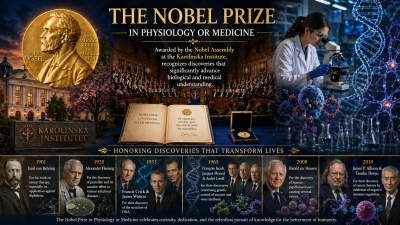
The Nobel Prize in Physiology or Medicine, awarded by the Nobel Assembly at the Karolinska Institute, recognizes discoveries that significantly advance biological and medical understanding.
Foundational Laureates: Establishing Biological Principles
Early 20th-century prizes formed the basis of modern cell biology, genetics, and infectious disease control.
- Emil von Behring (1901): The first recipient, honored for his work on serum therapy, specifically for developing an antitoxin against diphtheria.
- Sir Ronald Ross (1902): Recognized for discovering how malaria enters the organism via mosquitoes; his research was conducted largely in India (Secunderabad).
- Robert Koch (1905): Awarded for his investigations into tuberculosis and the development of “Koch’s Postulates,” which link specific microbes to specific diseases.
- Karl Landsteiner (1930): Discovered the human blood groups (ABO system), enabling safe blood transfusions.
- Alexander Fleming, Ernst Chain, and Howard Florey (1945): Honored for the discovery of Penicillin and its curative effect in various infectious diseases.
Molecular and Genetic Breakthroughs
These awards trace the evolution of our understanding of DNA and the central dogma of molecular biology.
- James Watson, Francis Crick, and Maurice Wilkins (1962): Discovered the double helix structure of DNA, providing the physical basis for heredity.
- Barbara McClintock (1983): Discovered mobile genetic elements (transposons) or “jumping genes” in maize, challenging the static view of the genome.
- Stanley B. Prusiner (1997): Discovered Prions, a new biological principle of infection consisting solely of misfolded proteins (linked to Mad Cow Disease).
Recent Nobel Laureates (Current Affairs Focus: 2023–2025)
UPSC Prelims often focus on the scientific principles behind the most recent awards.
| Year | Laureate(s) | Key Discovery | Scientific Significance |
| 2025 | M. Brunkow, F. Ramsdell, S. Sakaguchi | Peripheral Immune Tolerance | Discovery of Regulatory T cells (Tregs) and the FOXP3 gene; crucial for treating autoimmune diseases and preventing organ rejection. |
| 2024 | Victor Ambros, Gary Ruvkun | microRNA | Foundational mechanism for post-transcriptional gene regulation, explaining how different cell types develop despite having the same DNA. |
| 2023 | Katalin Karikó, Drew Weissman | mRNA Vaccines | Nucleoside base modifications that allowed the development of effective mRNA vaccines against COVID-19. |
| 2022 | Svante Pääbo | Paleogenomics | Sequencing the genome of extinct hominins (Neanderthals and Denisovans) to understand human evolution. |
Nobel Laureates with Indian Connections
Candidates must distinguish between Indian citizens, Indian-born laureates, and those whose work was conducted in India.
- Har Gobind Khorana (1968): Awarded for his interpretation of the genetic code and its role in protein synthesis. He was an Indian-born American citizen.
- Venkatraman Ramakrishnan (2009): Received the Nobel Prize in Chemistry (often classified under Biological Sciences) for mapping the structure and function of the ribosome at the atomic level.
- Sir Ronald Ross (1902): A British citizen whose Nobel-winning research on the transmission of malaria by mosquitoes was conducted in India.
Nobel Prize Quick Facts for Prelims
- First Woman Laureate: Gerty Cori (1947) for her work on glycogen metabolism (Cori cycle).
- Youngest Laureate: Frederick Banting (32 years old in 1923) for the discovery of insulin.
- Oldest Laureate: Peyton Rous (87 years old in 1966) for the discovery of tumor-inducing viruses.
- Posthumous Rules: Since 1974, the prize cannot be awarded posthumously unless the laureate dies after being announced (e.g., Ralph Steinman in 2011).