

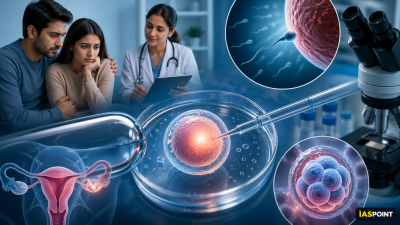
Assisted Reproductive Technologies (ART) include all fertility treatments in which both eggs and sperm are handled. These techniques are used to address infertility—the inability to conceive or produce children even after two years of unprotected sexual cohabitation.
1. In Vitro Fertilization (IVF) and Test Tube Baby Programme
IVF is the most common ART procedure, where fertilization occurs outside the body in conditions simulating the natural environment.
- Process: Ova from the wife/donor and sperm from the husband/donor are collected and induced to form a zygote in a laboratory.
- Embryo Transfer (ET): The resulting zygote or early embryo is then transferred into the female’s reproductive tract.
Sub-types of Embryo Transfer:
- ZIFT (Zygote Intra-Fallopian Transfer): The zygote or early embryo (with up to 8 blastomeres) is transferred into the Fallopian tube.
- IUT (Intra-Uterine Transfer): Embryos with more than 8 blastomeres are transferred directly into the uterus to complete further development.
2. Gamete Intra-Fallopian Transfer (GIFT)
GIFT is used for females who cannot produce an ovum but can provide a suitable environment for fertilization and embryonic development.
- Procedure: An ovum collected from a donor is transferred into the Fallopian tube of the recipient.
- Fertilization: Unlike IVF, fertilization in GIFT occurs in vivo (inside the body).
3. Intra-Cytoplasmic Sperm Injection (ICSI)
ICSI is a specialized procedure used primarily to treat male infertility, particularly when sperm count is extremely low or sperm motility is poor.
- Procedure: A single sperm is directly injected into the cytoplasm of the ovum in the laboratory to form an embryo.
4. Artificial Insemination (AI)
This technique is used when the male partner is unable to inseminate the female or has a very low sperm count (Oligospermia).
- Procedure: Semen collected from the husband or a healthy donor is artificially introduced into the vagina or the uterus.
- IUI (Intra-Uterine Insemination): When the semen is introduced specifically into the uterus, it is referred to as IUI.
5. Surrogacy
Surrogacy involves a woman (the surrogate) carrying a pregnancy for another person or couple (the intended parents).
- Gestational Surrogacy: The surrogate has no genetic link to the child; the embryo is created via IVF using the intended parents’ (or donors’) gametes and then transferred to the surrogate’s uterus.
- Legal Aspect (India): The Surrogacy (Regulation) Act, 2021 allows only altruistic surrogacy and bans commercial surrogacy in India.
Comparative Summary of ART Techniques
| Technique | Site of Fertilization | Target Body Part | Primary Use Case |
| ZIFT | In Vitro (Lab) | Fallopian Tube | Early stage embryo transfer |
| IUT | In Vitro (Lab) | Uterus | Late stage embryo transfer |
| GIFT | In Vivo (Body) | Fallopian Tube | Female unable to produce ova |
| ICSI | In Vitro (Lab) | Ovum Cytoplasm | Severe male infertility |
| IUI | In Vivo (Body) | Uterus | Low sperm count/motility |
Legal and Regulatory Framework in India
For UPSC Prelims, understanding the statutory framework is essential:
- ART (Regulation) Act, 2021: * Established a National Registry and Registration Authority for ART clinics and banks.
- Sets age limits for donors and patients (Women: 21–50 years; Men: 21–55 years).
- Mandates insurance coverage for oocyte donors.
- PCPNDT Act, 1994: Strictly prohibits the use of ART or any other technique for sex selection or pre-natal sex determination.
UPSC Prelims Fact File
- Oligospermia: A condition of low sperm count.
- Azoospermia: Complete absence of sperm in the ejaculate.
- In Vivo vs. In Vitro: In vivo refers to biological processes occurring within the living organism; In vitro refers to processes performed in a controlled environment outside a living organism (e.g., a test tube or petri dish).
- Cryopreservation: The process of freezing embryos, sperm, or eggs at very low temperatures (usually using liquid nitrogen at -196°C) for future use in ART.