

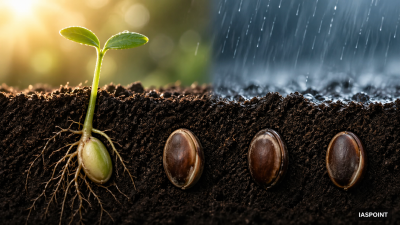
Seed dormancy is a state in which seeds are prevented from germinating even under environmental conditions normally favorable for germination (such as adequate water, oxygen, and temperature). This is a survival mechanism that ensures seeds germinate only when the probability of seedling survival is high.
Causes of Seed Dormancy
The reasons for seed dormancy can be internal to the seed or dictated by the immediate environment:
- Impermeable Seed Coat: A hard, thick seed coat prevents the entry of water (imbibition) and oxygen.
- Chemical Inhibitors: Presence of growth-inhibiting substances like Abscisic Acid (ABA), phenolic acids, or para-ascorbic acid.
- Immature Embryo: The embryo may not be fully developed at the time of seed dispersal.
- Light Requirement (Photoblastism): Some seeds require a specific exposure to light (or a period of darkness) to initiate the germination process.
Methods of Breaking Seed Dormancy
For agricultural and horticultural purposes, dormancy must often be broken artificially:
- Scarification: Physical or chemical weakening of the seed coat. This can be done using sandpaper (abrasion), knives, or soaking in concentrated sulfuric acid.
- Stratification: Subjecting seeds to a period of low temperature (chilling) under moist conditions to trigger metabolic changes.
- Hormonal Treatment: Application of Gibberellic Acid (GA3) or Nitrates to neutralize the effect of inhibitors like ABA.
- Environmental Changes: Altering light conditions or providing alternating temperatures.
Process of Seed Germination
Germination is the process by which the embryo inside the seed resumes growth and develops into a seedling.
Steps in Germination
- Imbibition: The physical absorption of water by the dry seed, causing it to swell and rupture the seed coat.
- Activation: Water activates enzymes (like alpha-amylase) that break down stored food (starch) into simple sugars (glucose) to provide energy for the growing embryo.
- Radicle and Plumule Emergence: The radicle (future root) is the first part to emerge, followed by the plumule (future shoot).
Types of Seed Germination
| Type | Description | Examples |
|---|---|---|
| Epigeal Germination | The hypocotyl elongates, and the cotyledons are pushed above the soil surface. | Bean, Castor, Sunflower, Cotton |
| Hypogeal Germination | The epicotyl elongates, and the cotyledons remain below the soil surface. | Pea, Gram, Maize, Coconut |
| Viviparous Germination | Seeds germinate while still attached to the parent plant; common in saline habitats. | Mangroves (e.g., Rhizophora) |
Factors Regulating Germination
- Water: Essential for enzymatic activity and the breakdown of reserve food.
- Oxygen: Required for aerobic respiration to provide energy for cell division.
- Temperature: Most seeds germinate optimally between 25°C and 30°C.
- Light: Seeds that require light for germination are called “Positive Photoblastic” (e.g., Lettuce), while those inhibited by light are “Negative Photoblastic” (e.g., Onion).
Hormonal Regulation: The ABA-GA Balance
The transition from dormancy to germination is largely governed by the antagonistic relationship between two hormones:
- Abscisic Acid (ABA): The “Dormancy Inducer.” It maintains the seed in a quiescent state and helps it survive desiccation.
- Gibberellins (GA): The “Germination Promoters.” They stimulate the synthesis of hydrolytic enzymes like α-amylase, which mobilizes food reserves.
- Ratio Significance: Germination occurs when the internal concentration of GA outweighs the concentration of ABA.
UPSC Prelims Facts & Trivia
- Tetracyllium Test: This chemical test (using 2,3,5-triphenyl tetrazolium chloride) is used to determine the viability of seeds. Living embryos turn red.
- Quiescence vs. Dormancy: Quiescence is a simple lack of germination due to unfavorable external conditions, whereas dormancy is an internal “lock” even if external conditions are perfect.
- Alpha-Amylase Induction: In cereal grains (like barley), Gibberellin is synthesized by the embryo and moves to the aleurone layer to trigger the production of alpha-amylase.
- Oldest Viable Seed: The record for the oldest viable seed belongs to Lupinus arcticus (Arctic Lupin), excavated from the Yukon tundra, estimated to be 10,000 years old. Another example is the Date Palm (Phoenix dactylifera) seed found at King Herod’s palace, which was 2,000 years old.