

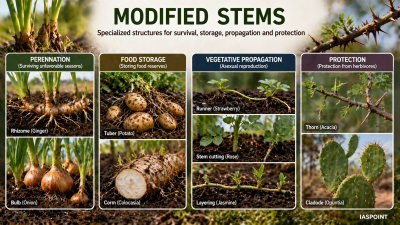
In many plant species, the stem is modified to perform specialized functions such as perennation (surviving unfavorable seasons), food storage, vegetative propagation, and protection.
Underground Stem Modifications
These stems grow below the soil surface and function primarily as storage organs and as a means of vegetative propagation. They are identified by the presence of nodes, internodes, and scale leaves.
| Modification Type | Structural Characteristics | Examples |
| Tuber | Swollen tips of underground branches; possess “eyes” (axillary buds). | Potato (Solanum tuberosum) |
| Rhizome | Fleshy, horizontal stem growing parallel to the soil surface; distinct nodes and internodes. | Ginger, Turmeric, Ferns, Lotus |
| Corm | Unbranched, vertically growing fleshy underground stem; stores large amounts of food. | Colocasia (Arvi), Amorphophallus (Zaminkand), Saffron |
| Bulb | Highly reduced conical stem surrounded by fleshy scale leaves; terminal bud is in the center. | Onion, Garlic |
Sub-aerial Stem Modifications
These stems are partially aerial and partially underground, primarily facilitating rapid vegetative spread (multiplication).
- Runner: Long, slender horizontal branches that crawl along the soil surface and root at the nodes (e.g., Grasses, Oxalis, Strawberry).
- Stolon: A lateral branch that grows aerially for some time and then arches downwards to touch the ground and produce a new plant (e.g., Mint, Jasmine).
- Offset: A short, thick lateral branch found in aquatic plants; it bears a rosette of leaves at the apex and a tuft of roots below (e.g., Pistia, Eichhornia or Water Hyacinth).
- Sucker: Arises from the underground portion of the main stem, grows horizontally under the soil, and then comes out obliquely upward to form a leafy shoot (e.g., Chrysanthemum, Banana, Pineapple).
Aerial Stem Modifications
These modifications occur on the parts of the plant exposed to the atmosphere, often as adaptations to specific environmental stresses.
- Stem Tendrils: Slender, spirally coiled structures that develop from axillary buds. They help weak-stemmed plants climb (e.g., Gourds like Cucumber, Pumpkin, and Watermelon; Grapevines).
- Thorns: Woody, straight, and pointed structures arising from axillary buds. They provide protection against grazing animals (e.g., Citrus, Bougainvillea).
- Phylloclade: Fleshy, green, flattened, or cylindrical stems that contain chlorophyll and perform photosynthesis. These are adaptations to arid regions to reduce water loss (e.g., Opuntia – flattened; Euphorbia – cylindrical).
- Cladode: A phylloclade with only one or two internodes (e.g., Asparagus, Ruscus).
- Bulbil: Modified axillary or floral buds that become fleshy and serve as organs of vegetative reproduction (e.g., Agave, Dioscorea).
Comparative Analysis: Stem vs. Root Modifications
A common point of confusion in UPSC Biology is distinguishing between storage organs.
- Sweet Potato vs. Potato: Sweet potato is a Root Tuber (adventitious root), whereas Potato is a Stem Tuber.
- Turmeric vs. Carrot: Turmeric is a Rhizome (stem), whereas Carrot is a Conical Tap Root.
- Onion: The edible part is the fleshy scale leaves, but the structure itself is a modified Bulb (stem).
UPSC Prelims Fact Sheet: Stem Modifications
- Water Hyacinth (Eichhornia): Known as the “Terror of Bengal,” it propagates extremely fast through offsets, leading to oxygen depletion in water bodies.
- Photosynthesis in Cacti: In plants like Opuntia, leaves are modified into spines to prevent transpiration, and the Phylloclade (stem) takes over the role of photosynthesis.
- Perennation: Underground stems like ginger and zaminkand act as organs of perennation to tide over conditions unfavorable for growth.
- Eyes of Potato: These are actually nodes. If a potato slice with an “eye” is planted, it can grow into a new plant, demonstrating vegetative propagation.