

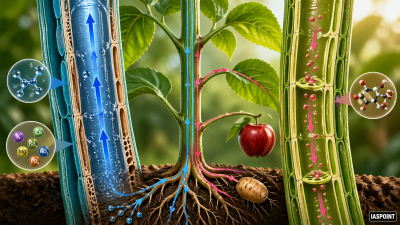
In plant physiology, transport is categorized into two distinct processes based on the distance covered and the materials moved. While water and minerals travel upward through the xylem, the organic solutes—primarily sucrose—are moved via the phloem through a process known as translocation.
Mechanism of Water and Mineral Transport
The movement of water from roots to the aerial parts of the plant is explained by the Cohesion-Tension-Transpiration Pull Theory. Unlike the transport of food, this process is largely passive, driven by the physical properties of water and the environmental demand for vapor.
Key Components of Xylem Transport
- Root Pressure: A positive pressure developed in the xylem of roots due to active ion absorption, contributing to the upward push of water in small herbaceous plants.
- Cohesion and Adhesion: Cohesion is the mutual attraction between water molecules, while adhesion is the attraction of water molecules to polar surfaces like tracheary elements.
- Transpiration Pull: The driving force created by the evaporation of water from leaf stomata, creating a negative pressure (suction) that pulls the water column upward.
Translocation of Organic Solutes (Phloem Transport)
Translocation refers to the long-distance movement of organic nutrients through the phloem. Unlike xylem transport, which is unidirectional (upward), phloem transport is multidirectional, moving from “Source” to “Sink.”
Source and Sink Relationship
- Source: The part of the plant that synthesizes food (primarily leaves) or regions that mobilize stored food (e.g., germinating seeds or tubers in spring).
- Sink: The regions that need or store food, such as roots, fruits, seeds, and developing buds.
- Dynamic Nature: The source-sink relationship is not fixed. For example, a sugar beet root is a sink in the first year but becomes a source in the second year to support the growth of flowers.
The Pressure Flow or Mass Flow Hypothesis
Proposed by Ernst Münch, this is the most accepted mechanism for phloem translocation. It describes the movement of sap due to a hydrostatic pressure gradient.
Stages of Mass Flow
- Phloem Loading: At the source, sucrose is actively transported (using ATP) into the companion cells and then into the sieve tube elements.
- Osmosis: The high concentration of sucrose in the sieve tube creates a hypertonic environment, causing water to move from the adjacent xylem into the phloem by osmosis.
- Hydrostatic Pressure Build-up: The entry of water increases the turgor pressure (hydrostatic pressure) at the source end.
- Mass Flow: The sap moves toward areas of lower pressure (the sink).
- Phloem Unloading: At the sink, sucrose is actively moved out of the phloem to be used or stored as starch. Water subsequently moves back into the xylem.
Comparison of Xylem and Phloem Transport
| Feature | Xylem Transport | Phloem Transport |
| Material Transported | Water and dissolved minerals | Organic solutes (Sucrose), Amino acids, Hormones |
| Direction | Unidirectional (Root to Shoot) | Multidirectional (Source to Sink) |
| Conducting Cells | Tracheids and Vessels (Dead cells) | Sieve tubes and Companion cells (Living cells) |
| Energy Requirement | Mostly passive (driven by Transpiration) | Active process (requires ATP for loading/unloading) |
| Mechanism | Transpiration Pull / Cohesion-Tension | Pressure Flow (Mass Flow) Hypothesis |
Critical Facts for UPSC Prelims
Nature of Translocated Solutes
While glucose is the primary product of photosynthesis, it is converted into sucrose (a non-reducing sugar) for transport because sucrose is chemically stable and less reactive during the journey through the phloem. It is finally stored as starch (insoluble).
The Girdling Experiment
This experiment proves that phloem is responsible for food transport. When a ring of bark (including the phloem) is removed from a tree trunk, the downward movement of food stops, causing the bark above the ring to swell. The roots eventually die first due to a lack of nutrients.
Sieve Tube Characteristics
Sieve tube elements are unique living cells that lack a nucleus at maturity. Their functions are controlled by the nucleus of the adjacent Companion Cells, which are specialized parenchyma cells connected by plasmodesmata.
Factors Affecting Translocation
- Temperature: Optimal temperatures increase metabolic activity and the rate of active loading.
- Metabolic Inhibitors: Since phloem loading requires ATP, substances that inhibit cellular respiration (like cyanide) stop translocation.
- Phloem Sap Composition: It consists mainly of water and sucrose, but it also carries hormones (like auxins and gibberellins), amino acids, and some minerals in an alkaline environment (pH 7.5 to 8.5).